A Short Course on Improvisation
Part One - piano improvisation
Ideally, improvisation is produced spontaneously without any preparation. It is a form of composing which can cover short or long passages, four-bar or eight-bar phrases or rest bars with space to be used. Only experience and common sense determine how much of a tune can be improvised without overdoing it.
The excitement generated in a performance can be transmitted from one player to another, stimulating the flow of new ideas and encouraging the musicians to improvise. A solo pianist does not always enjoy this kind of atmosphere unless he is playing with bass and drums or has a particularly responsive audience which is why some of the most exciting piano solos occur in a band setting.
Not many jazz players have the ability to create new improvisations every time they tackle a number. If a good improvisation was fashioned on a previous playing of the tune it is more than likely that it will be repeated. What seems to be happening is that a musician's interpretation of anything he plays is determined by how he has played it before.
At the beginning the tune is treated more or less as written then some improvisation is added with little twists and embellishments from other numbers of a similar character. So every time the same number is played the musician will add fragments of his own improvisations plus various elements borrowed from other performances. Eventually, with all these additions the tune is reshaped and gives the impression that the musician has produced a clever improvisation when in fact he has really been recalling ideas not necessarily of his own invention. It follows that if you can store up a large enough selection of jazz patterns from any source plus some additions of your own, however modest, you can arrange or "improvise" on any number you play in a way which will appear to be spontaneous and exciting to an unsuspecting audience.
It is possible that over many years a performer will have altered and "improvised" on his favorite pieces to a point where they fit into a kind of ideal form where no further changes or variations seem to be justified. When this happens a player will repeat his arrangement in the same way every time he plays it.
Professional jazz musicians appearing in concerts often play planned improvisations to avoid the fatigue and strain of tearing out their hearts at every performance.
Like the skilled actor they can simulate the passionate and exciting solo by drawing on the vast stockpile of previous improvisations to dress up the tune being played. The more inspired and talented jazz musicians do go on producing new ideas but musicians of that calibre are in the absolute minority.
The brilliant jazz performance is far more clinical than you might imagine: probably something like 60 percent knowledge, 20 percent creative inspiration, 10 percent audience reaction and 10 percent luck!
The beginner who wishes to develop his abilities to improvise, arrange, or alter the pieces he plays will need to get to know some of the rules for doing this.
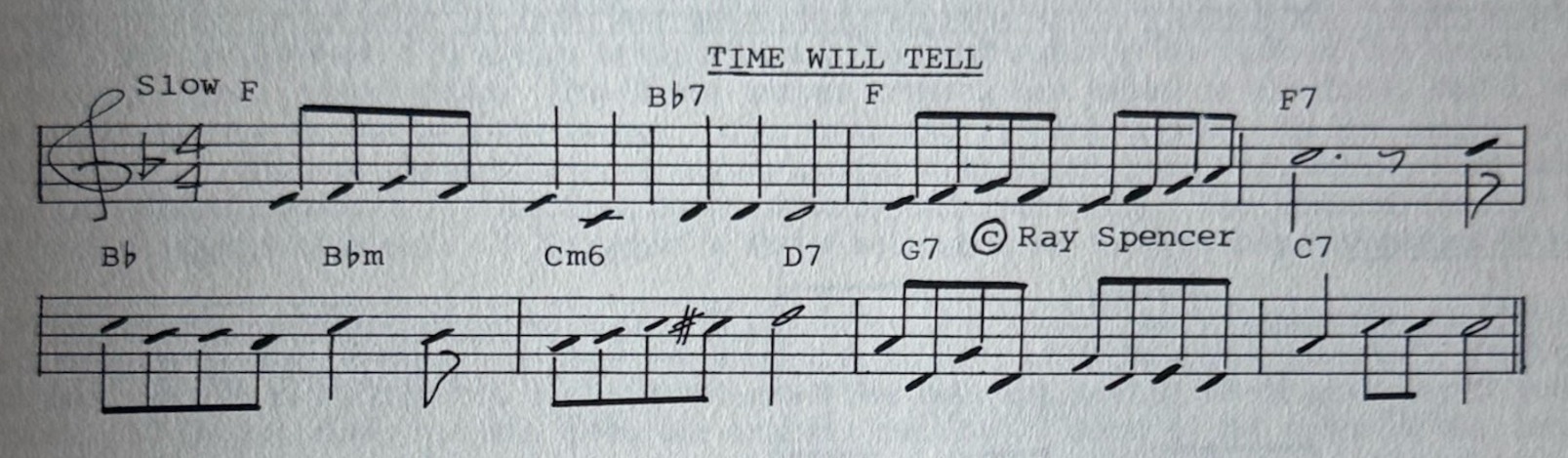
Before you can improvise you have to have material to work on so I am using one of my own compositions as a basis for this exercise.
Part Two - piano improvisation
The beginner needs to understand harmony and precisely what is possible with a chord sequence. Any number he plays should be read from the song copy first of all so that the melody is accurately learnt. If there are words then learn them as well as they often indicate the correct phrasing more clearly than the notes themselves. I feel that is is essential to acquire this understanding of every number in your repertoire. It is only then that you can be in the position of attempting to make those alterations and additions which are loosely referred to as improvisation.
Assuming that you have read and learnt a piece so that you are fully acquainted with its mood and character you can then consider how an improvisation should be tackled. First of all play the melody on its own without any accompaniment and try to phrase it so that it has a jazz feeling not necessarily present in the original composition. When this has been carried out the harmony can be examined to see if it can be improved.
The next step is to play the chords without the melody as an accompaniment. Spread the voicing over both hands and then try the left hand on its own.
If you have added chords to fill out the harmony try them with the straight melody to see how they fit in. Make any adjustments which help the two elements to blend together.
Improvisation can take place when the harmony is changed, added to or altered from its original pattern. If you arrange the notes of the chord changes in a logical melodic pattern you are improvising. Although it would not satisfy all musicians, playing the straight melody with jazz phrasing in combination with improved chord voicing is an acceptable way of playing for the beginner who is feeling his way and trying to learn the art of improvising.
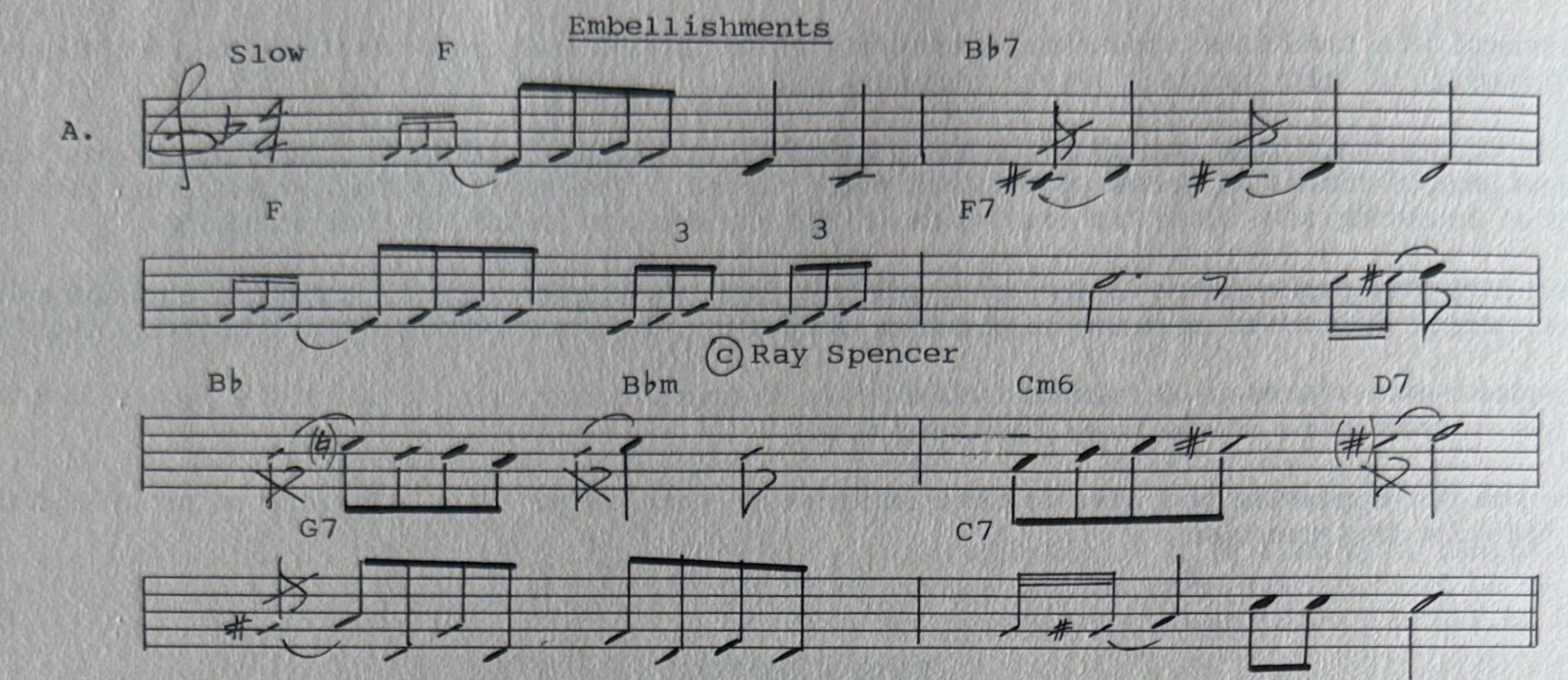
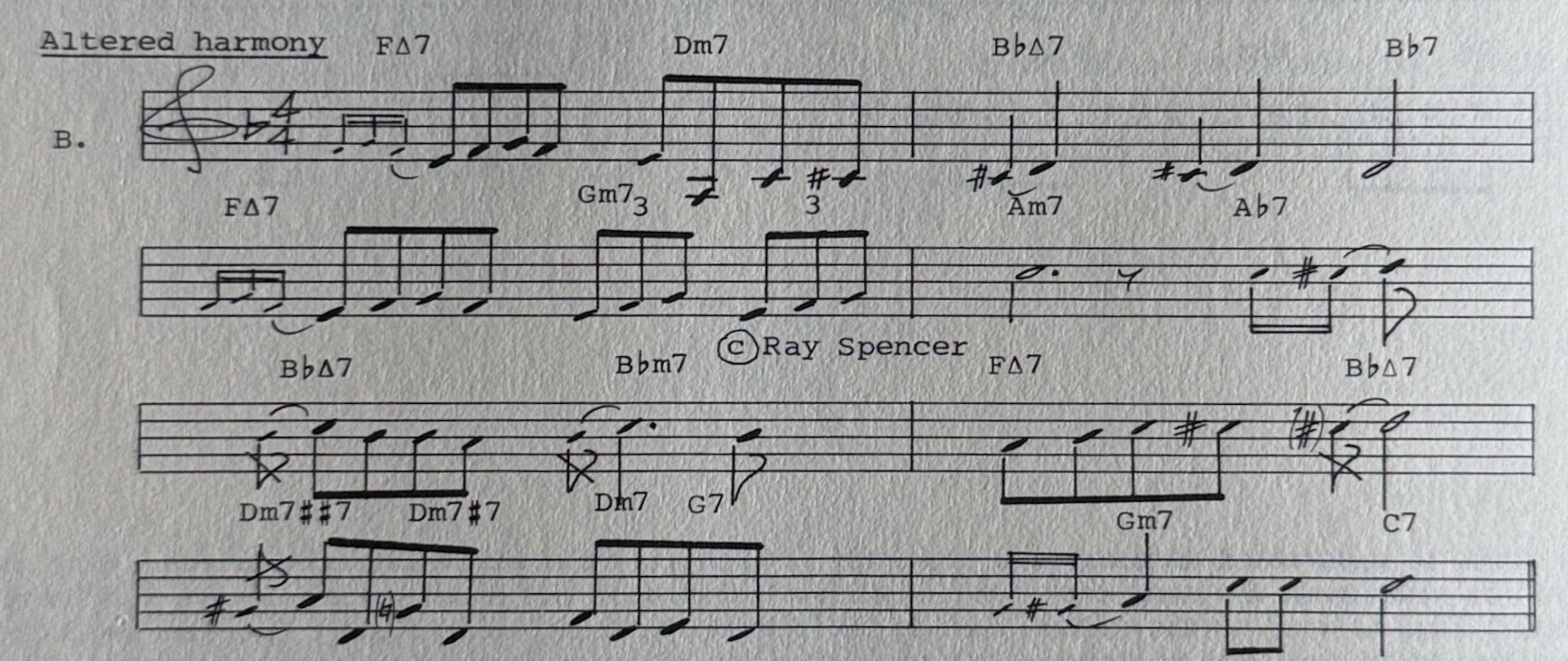
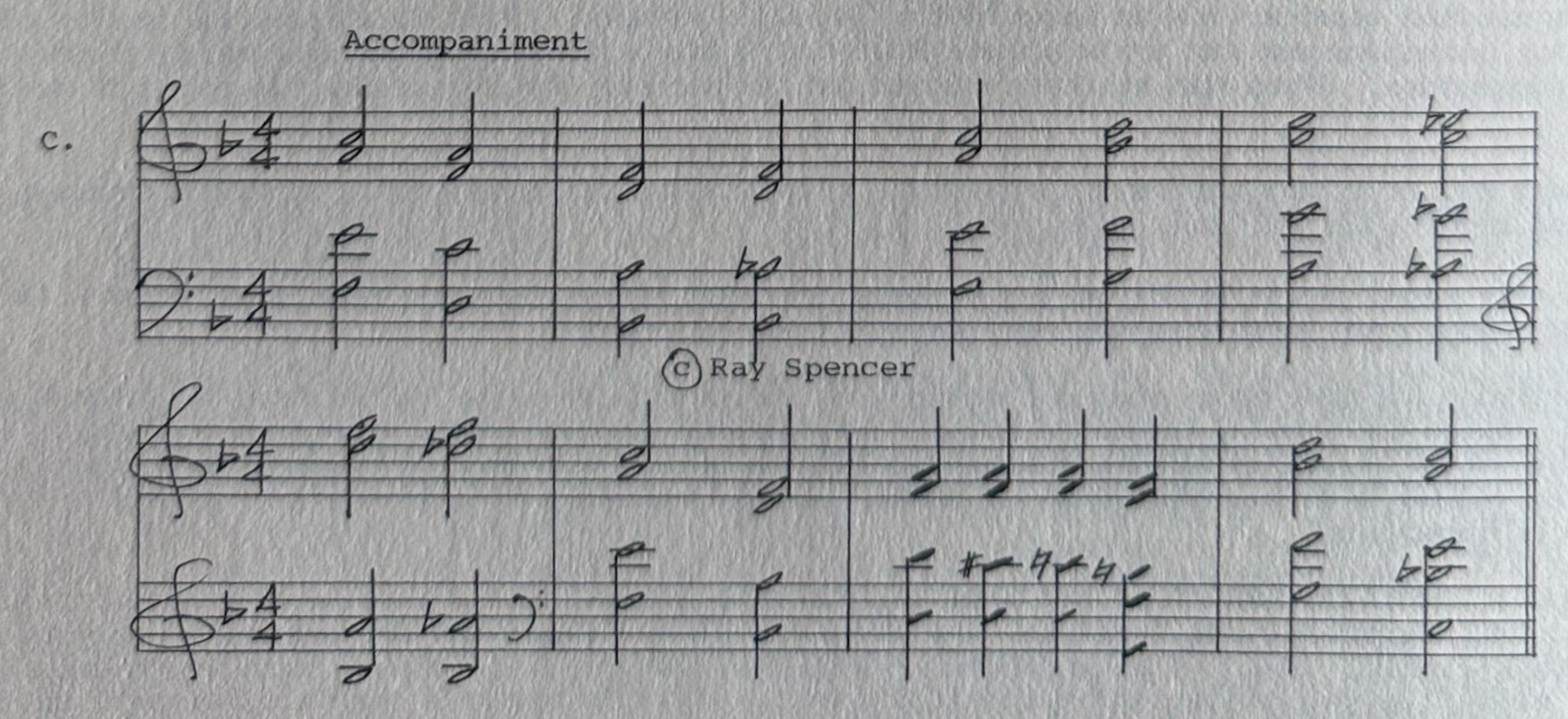
Example A shows the melody we are using for our experiments in improvisation with some embellishments and a slight alteration in the third bar. In example B I have "improved" the original harmony by adding some diatonic chords. The ♯♯7 is an octave. Finally, in Example C the altered harmony is spread out between both hands. As you can see the third and fifth of the chord is voiced in the right hand with the left playing the root and seventh.
Part Three - piano improvisation
So far we have tackled the eight-bar theme by rephrasing it with the use of embellishments and then filling out the harmony by adding chords which were not included in the original illustration. We are now in a position to see what can be done with the melody and improved chords to create an improvisation.
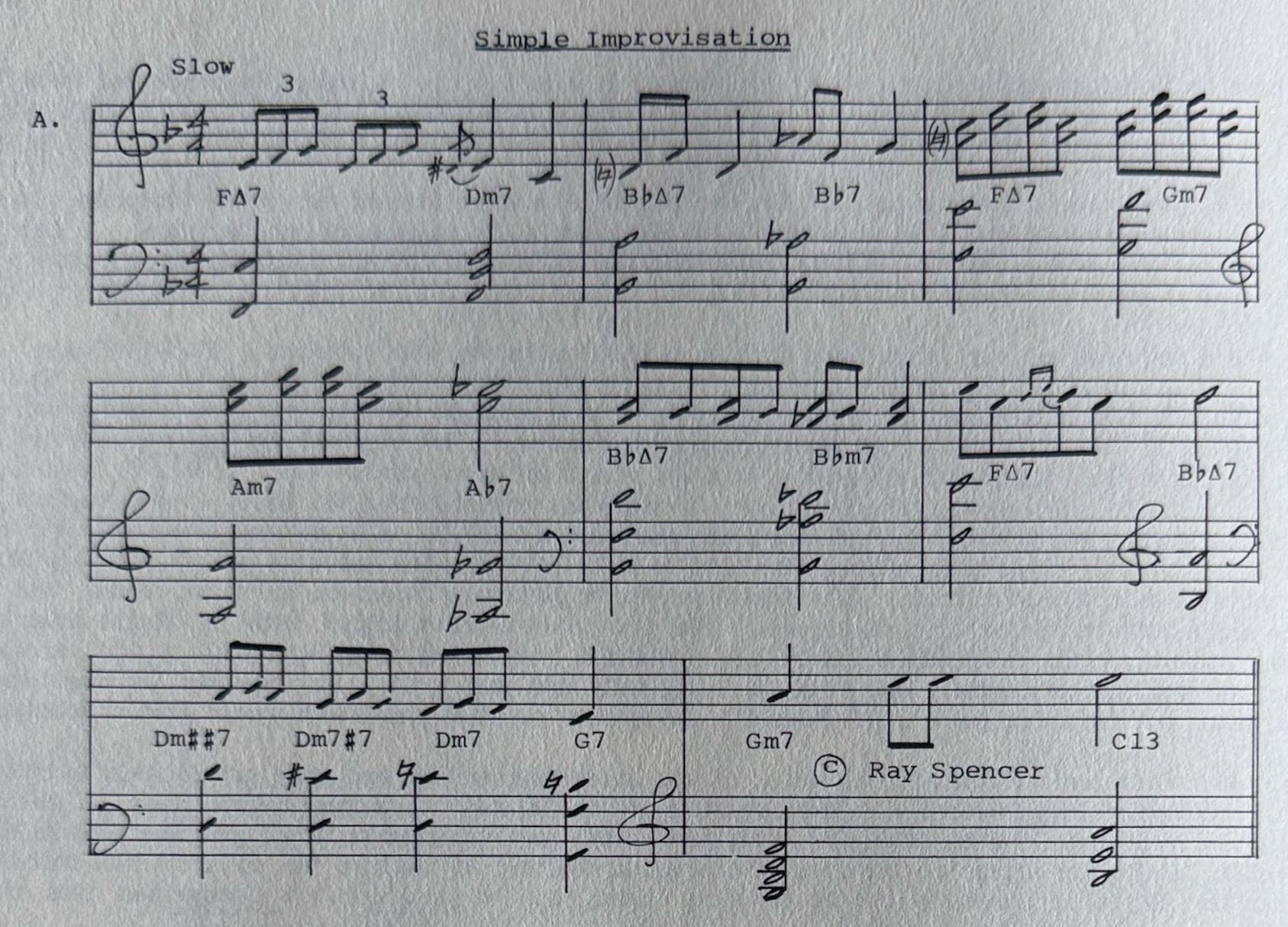
Put the original theme by example A. In bar one of A I have formed two quaver triplets out of the first three quavers in the original. The notes of the B♭ chords are manipulated in bar two. In bar three the original melody was scale-like. I felt that breaking up the chords into thirds would be effective. This kind of treatment is carried out in bar four as well.
The chord sequence of bars three and four is a basis of many jazz patterns. FΔ7-Gm7-Am7 are diatonic chords built on the F Major scale. Am7 might in certain circumstances lead on to a D7. The A♭7 is a tritone substitute for D7. The top note of the intervals plus the single notes in bar five use the notes of the first three quavers in the original but with their sequence altered. The original bar six had a short run of notes up to the minim D. The altered version because of the different chords (FΔ7 & B♭Δ7) required a different approach to the D. The new phrase is more or less based on the notes of the FΔ7. In the original bar seven the supporting chord was a G7. A Dm7 has been put before the G7. I have used three variations on the minor seventh. The Dm♯♯7 is a D minor triad with a D an octave above the root of the chord. The DmΔ7 is a major seventh with a minor triad. The three quaver triplets are based on the first, third, and fifth notes of the eight quavers in the original theme. The first note of each triplet with the single crotchet E make a scale pattern. This is straightforward improvisation worked out from both melody and harmony without involving any difficult patterns. The final bar originally had just a C7. The updated version has a Gm7 as well but instead of finishing on a C7 I thought a three note rootless thirteenth would give a sharper sound.
There is nothing complicated in all this. If you know your scales and understand basic harmony the only element missing is imagination. In improvisation this boils down to having a good ear. A sense of the melodic will lead you on to making the right decisions. You may not need a lot of guessing if you keep to the basic rules: 1) Do not stray too far from the original melody; 2) Stick to the notes of the chords; and 3) Remember that if you improve the chords anything added must be justified by a recognized rule of harmony.
There is another way of improvising which should be considered. If you change the harmony of a number using more modern chord voicings this in itself is musically creative and more enterprising than just improving the original harmony. It is possible to completely alter a chord sequence.
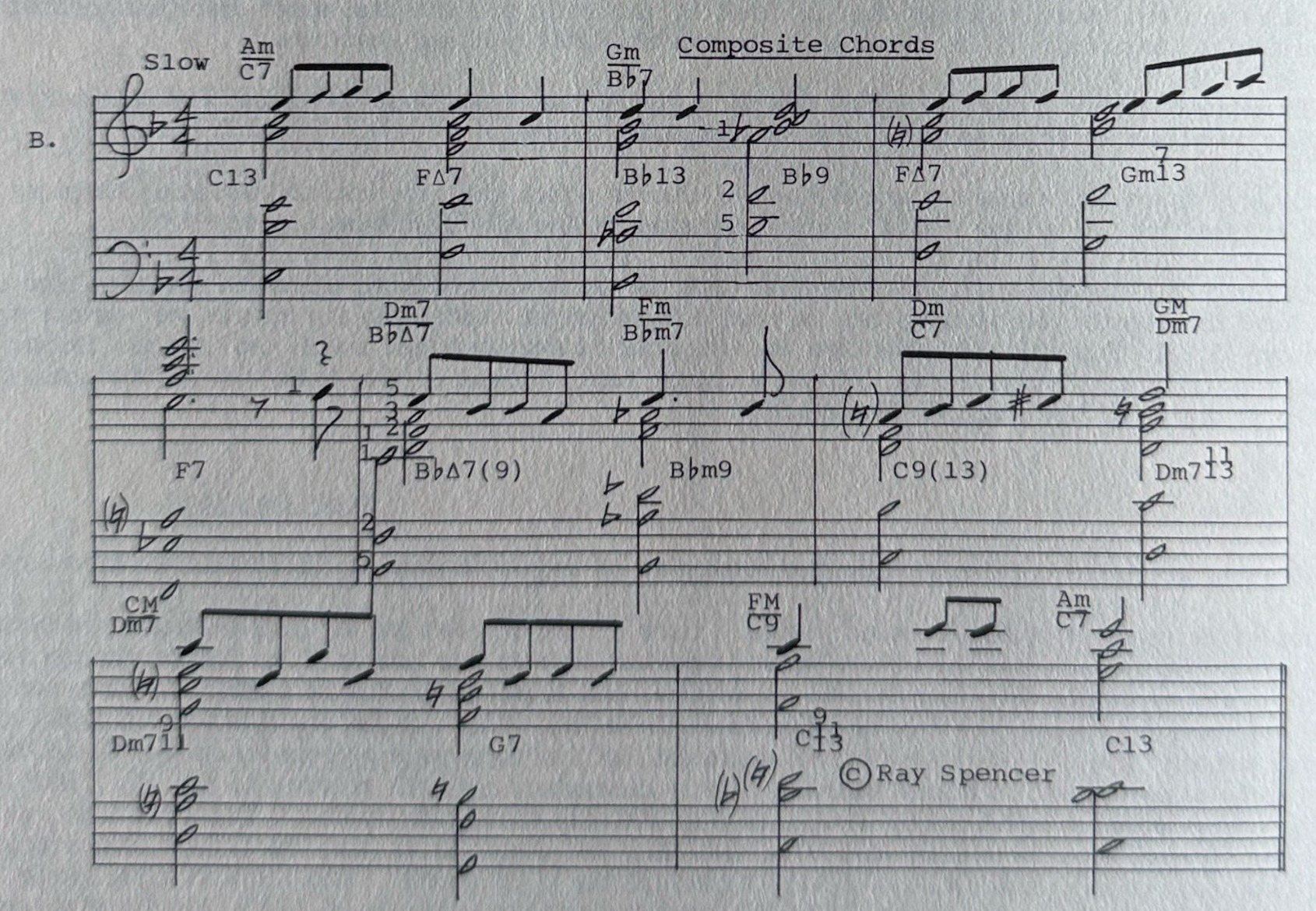
In Example B I have used composite chords in six of the eight bars. I expect you will notice that some of them were not included in the tables of composite chords.
Obviously, there are endless combinations of chords which can give unusual sounding harmony. I have kept to the original melody so any "new" sound originates in the chord voicing.
In building up composite chords remember that the name of the chord indicates the root note from which you form the chords you want to use in your left and right hands. In the charts we worked on C7 chords for our I7. In Example B in bar two the composite chord is based on B♭ so that the Roman numerals would form a fraction of VI over I7 to indicate a minor triad formed on the sixth note of the scale of B♭ over a B♭7 which is the I7 of the scale of that name.
Part Four - piano improvisation
I thought it would be useful to give two further examples of improvisations on the theme we have been using.
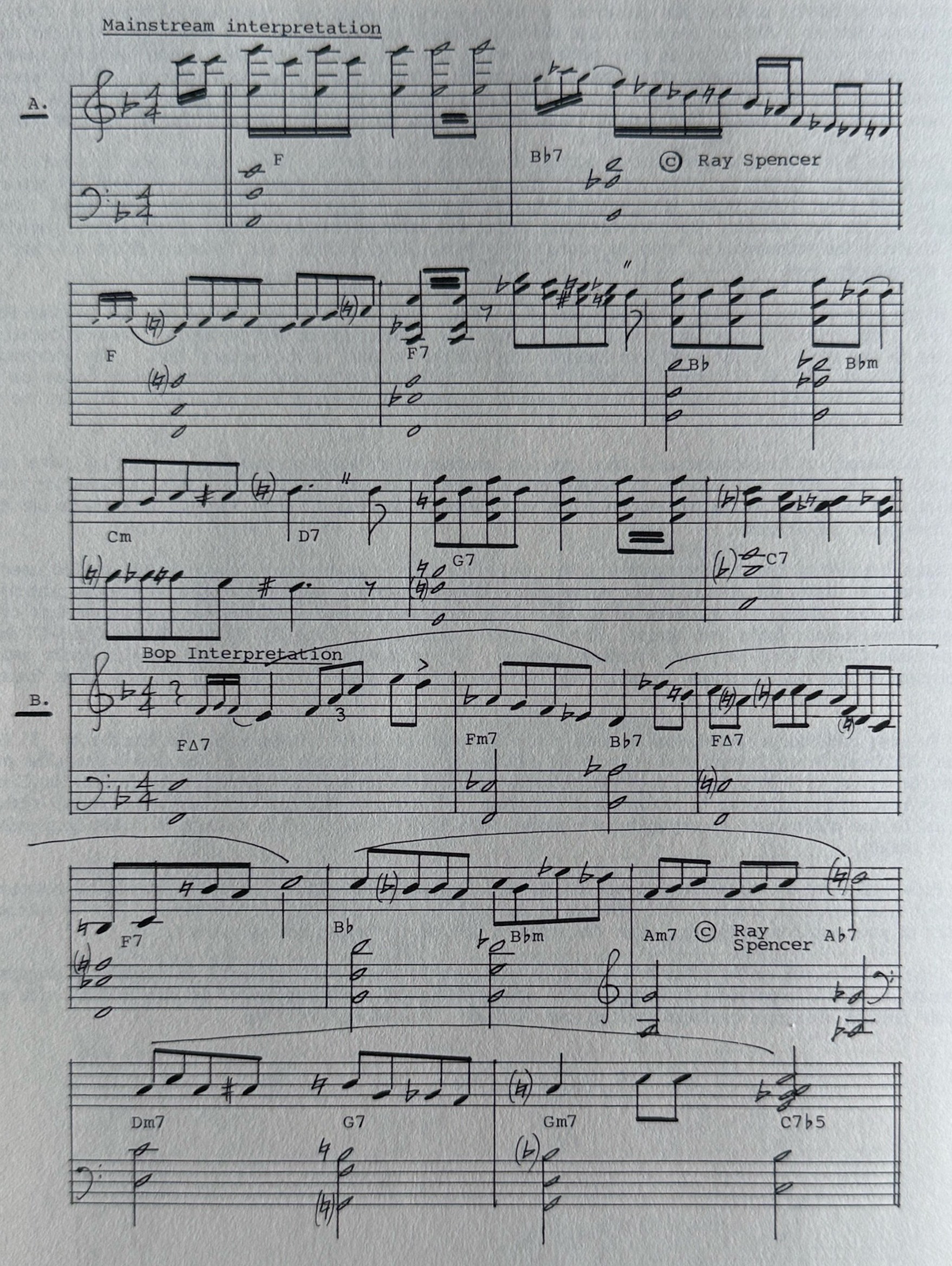
Compare Example A with the basic theme. Here I have worked out an improvisation which is mainstream in style. In the original theme the most important note in bar one is E so I have pivoted an octave on E with a C above middle C. Bar two of the original had three Ds on top of a B♭7. I have used a dominant scale with passing notes. B♭7 is the dominant in the key of E♭ so the scale has three flats--the two D flats are the passing notes. The third bar is unaltered but bar four uses a tremolo on the F7 in the right hand followed by a movement in thirds which is partly chromatic and still relative to the F7. Bar five returns to the octave pattern in the right hand fitting in with the three note tenths. The first four quavers in the treble are all part of a B♭ chord--the F is the fifth, the C the ninth, and the D is a major third. The remaining two quavers and crotchet are clearly a part of the B♭m chord. The left and right hands in bar six start to move in opposite directions. The C♯ in the right hand with the G in the left suggest an A7 chord which being a fifth above D7 leads into that chord. The seventh bar is made up from the notes of a G7 and the final bar with the chromatic thirds move towards the C7.
It might be claimed that improvisation is spontaneous and what I have described is calculated and rehearsed. It all depends on what is meant by spontaneous. What I have worked out was spontaneous in the sense that having played most of the patterns in the improvised eight bars hundreds of times in other numbers and musical situations I did not need to think too much about what I played. It flowed out with the aid of conditioned reflexes which led me on to play patterns which seemed suitable for this theme because those patterns had been played in other numbers of a similar character. But it should be remembered that all those patterns which reveal themselves so readily now were laboriously studied and practiced at an earlier stage. As I have said, these patterns are learnt, accumulated and stored up in the musical memory to be recalled when needed.
Example B shows an improvisation which has a bop sound to it. The melodic line in a lot of bop tunes is notated in eighths (quavers). The extended harmony is used in the improvisation. I have not attempted to write a bop left hand which is so often slightly behind the beat. Counter rhythms and unexpected accents all go to make up the bop sound. To over-simplify it for the sake of this brief look at bop-like improvisation it can be said that the extended intervals in chords with 9ths, 13ths, 11ths, and flattened fifths are particularly used in the melody line.
In example B the accented D in bar one is a 13th. In bar two in the key of B♭ the D♭ and B♮ are ♯9 and ♭9. The triplet in bar three is a rhythm which is used a lot in bop phrasing. The flattened fifth is used twice in bar four. In the next bar the 9th and 11th are a part of the melody line. The chromatic movement from Am7 to A♭7 is in character with the piece. This chord progression sometimes moves on to Gm7 and G♭7. The final two bars use the minor seventh followed by dominant sevenths. The C7 has the flattened fifth to give it some edge.
In this study of improvisation I have given a number of different approaches. They all have one thing in common in that either the melody is played more or less straight but with extended harmony or the melody is blended with the notes of the chords to make new melodic patterns or give them a jazz character not necessarily present in the original.
Most improvisations become patterns of one, two, four or eight bars' length which can be used on other occasions with different pieces. The more patterns you learn the better you will be able to improvise without previous preparation. If we were to study two or three dozen jazz numbers we would find that certain chord sequences occur again and again. For example: Dm7-G7 or Cm7-F7-B♭ and F-Dm-Gm7-C7 as well as sequences like C7-F7-B♭7-E♭7 and countless others. If you have cataloged in your mind melodic patterns for these sequences you can often use them in any number of tunes even if you have to slightly alter them to fit in.
We have considered the following jazz chord systems in earlier chapters in the handbook: 1) Diatonic Sevenths; 2) Minor Scale Sevenths; 3) Circle Of Fifths--(a) Dominant Sevenths; b) Dominant Sevenths preceded by Minor Sevenths; c) Whole Step Circle Movements; d) Half Step Circle Movements; 4) Chromatic Chord Movements--a) Tritone Substitution; b) Diminished Sevenths. If you have studied and understood these systems it should not be too difficult to incorporate something from this reservoir of knowledge to make improvisation easier to create.
Bars with chords which suggest one of the above groups, rest bars, or bridge passages between choruses lend themselves to improvisation based on the chord movements already outlined. Try to introduce them as a part of your improvisation and turn the notes of the chords into lines of melody.
Improvisation is rooted in knowledge; it is not just the result of accidental or haphazard inspiration or the stimulation of a sympathetic audience. The ability to improvise for most of us only comes with practice, repeatedly playing the same numbers, adding new and old ideas as best we can.