Boogie Woogie
Boogie Woogie is a special kind of left-hand rhythm used by early black pianists to accompany blues singers or to whip up a good pulsating beat when called on to play a blues solo for dancers. If a piano player was hired to perform at a house or rent party there was probably not always enough money available to include a drummer or guitarist so the pianist had to supply the necessary driving rhythm with his left-hand boogie patterns.
Boogie Woogie left-hand accompaniment did for the pianist of the late twenties and early thirties what the electronic rhythm-maker devices do for the modern organist.
Out of all the different boogie bass patterns the walking bass seems to be the only one which can be easily adapted to fit in with non-blues numbers.
I don't know whether we should be grateful to John Hammond for rediscovering Meade Lux Lewis in the mid-thirties and getting him to make a fresh recording of his famous "Honky Tonk Train Blues" because it triggered off a boogie woogie craze which Tin Pan Alley took up to the detriment of this style of piano playing.
Most of the early pioneers of boogie were unrecognized in their time which is why their reissued recordings sound so fresh and exciting. The recordings were originally found on American race labels long before the microgroove was invented. Records on such labels as Paramount, Okeh, and Vocalion were purchased by the Negro population. Later on jazz collectors discovered these fascinating 78s. Then eventually specialist jazz record companies reissued boogie gems to be enjoyed by a much wider audience.
It is difficult to determine when and how boogie woogie first started. The earliest recordings of blues pianists in a long line of boogie evolution were Lemuel Fowler (1923), Jimmy Blythe (1924), Hersal Thomas (1925), Cow Cow Davenport (1925) and Will Ezell (1928). Pinetop Smith (1928) and Jimmy Yancey (1939) were very influential players. There were many more pioneers like Charlie Spand, Cripple Clarence Lofton, Romeo Nelson, and Henry Brown.
The boogie woogie boom highlighted the talents of Albert Ammons, Meade Lux Lewis, and Pete Johnson who, it could be argued, were the most proficient and exciting players ever to record.
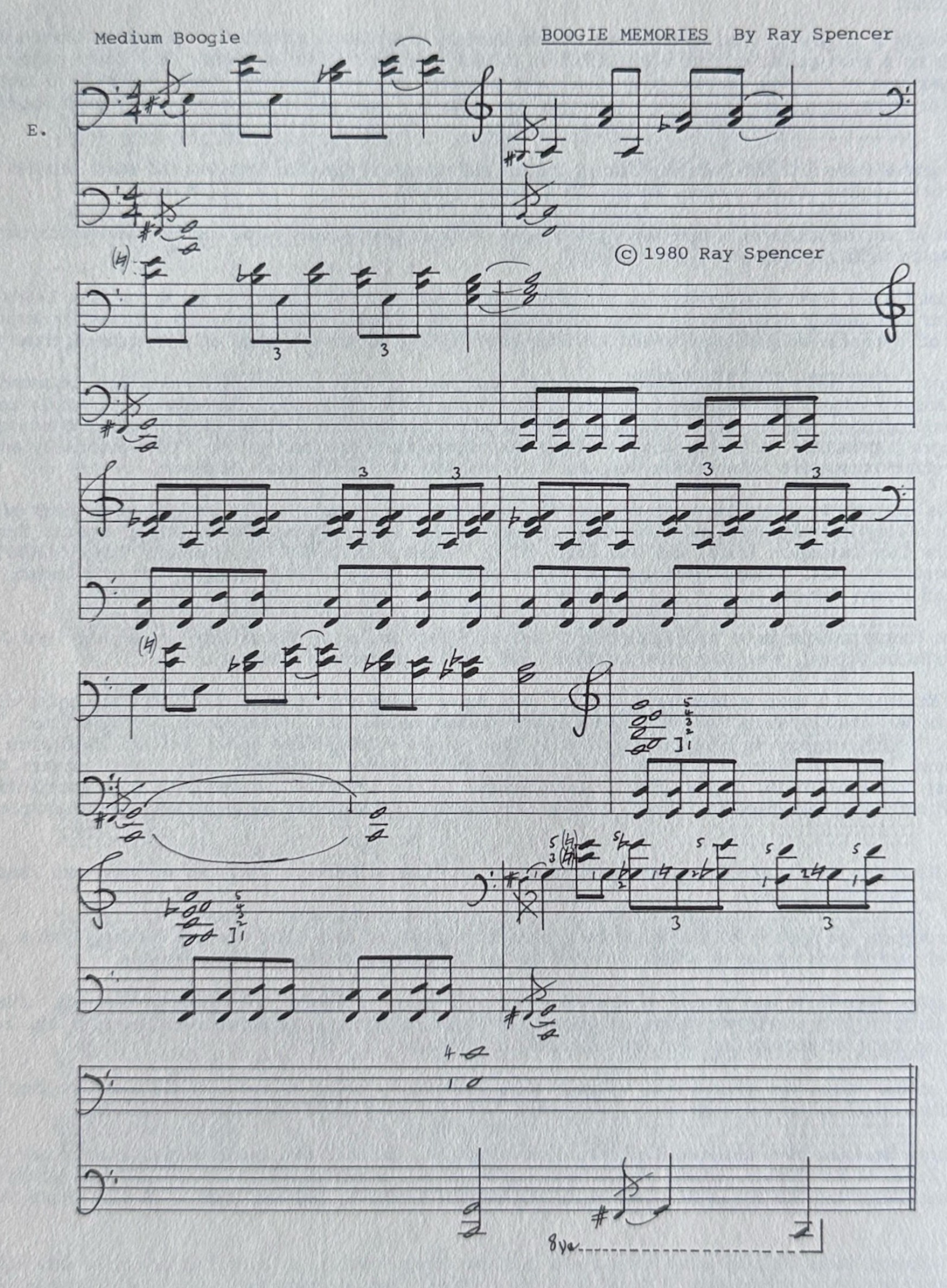
In Example A I have written out a walking bass for a twelve-bar blues in C. There are many different kinds of left-hand patterns. Some of them had traditional names like, "The Rocks," "Fives," and "Trenches." There seems to be some variation in these styles so that there is not just one rigid form for playing them. Montana Taylor's "Detroit Rocks" is the basic "Rocks" example. "The Fives" appears to have been Jimmy Yancey's, based on his "Five O'Clock Blues." "The Trenches" relates to Turner Parrish's 1933 solo but it may have had its roots in earlier, perhaps unrecorded, solos played by some long-forgotten travelling pianist.
In Examples B, C, and D you can examine these left-hand patterns. They can be used with Example A instead of the walking bass.

Throughout the history of jazz there have been musicians and fans alike who get involved with a particular style of playing and refuse to accept anything outside their area of interest as acceptable.
In piano jazz there are groups of devotees whose allegiance is limited to ragtime and stride, others specialize in blues and boogie and there are pockets of followers of the bop pianists and listeners who reject everything in favor of players like Jarrett, Hancock, and Taylor.
No matter whom you admire it is valuable to understand the different styles of all these exciting pianists who have stood out in the evolution of jazz piano from the twenties to present developments.
George Shearing is a musician like Dick Hyman who has the skill to be able to play jazz in any style from Bob Zurke to Art Tatum, Hines, and Wilson, on to Erroll Garner and Bill Evans. It must be obvious that this knowledge and facility is an asset which any player limited to just one style of playing would wish to possess.
So although there may be some of you who feel that Boogie Woogie is a limited or out of date kind of jazz with only historical significance I would urge you to take a broader view and learn how to expand your general knowledge of jazz piano.
It is, of course, understandable that we all like different things and try to make our prejudices seem like virtues instead of recognizing them for what they are. However, it is important not to have too narrow a horizon.
Example E is a boogie solo inspired by Meade Lux Lewis and Jimmy Yancey.