Chord Symbols
- The Structure of Chords · p. 1
- Numbered Scale System and Building Chords · p. 6
- Chord Books and Musical Form · p. 7
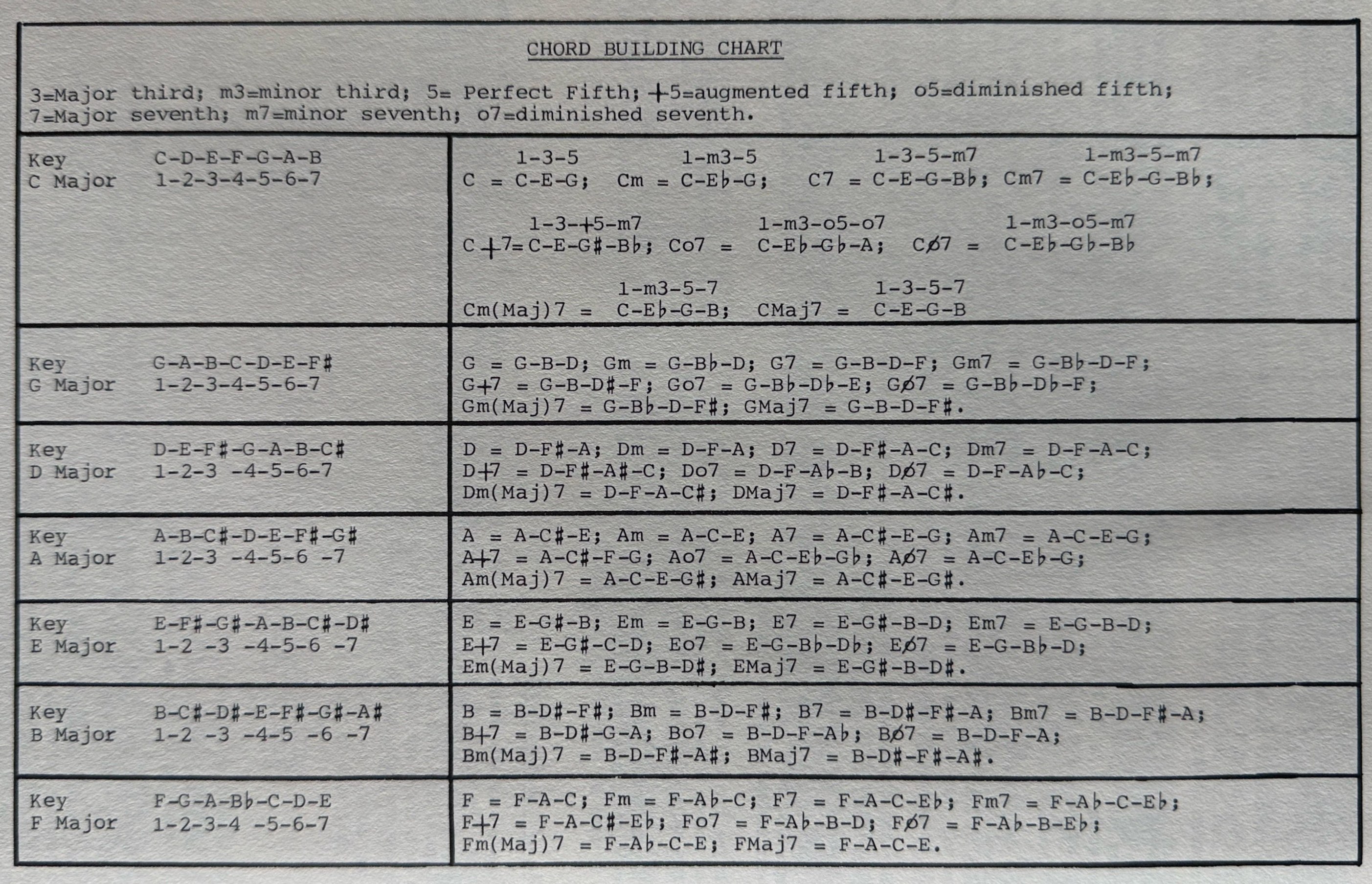
- Chord Building Chart · p. 8
- How To Use Chord Symbols With a Melody Line · p. 11
- How To Work Out a Piano Accompaniment From Chord Symbols · p. 13
Printed pages
Printed page 1
The Structure of Chords
It is a fact that there are many jazz musicians who manage to perform quite effectively without any real knowledge of music. Some of these musicians play entirely by ear, others cannot read music but can convert chord symbols into improvised patterns, and a third group are able to read band parts and busk but have no understanding of harmony or chord symbols. They all manage rather well until they are confronted with a musical problem which requires the knowledge they lack. Having, as it were, got away with it for so long it is understandable that jazzmen who fit into the above categories should consider it an unnecessary burden to have to start at the beginning again when their standard of playing has already reached a level of acceptance associated with trained musicians.
For the instrumentalist who plays by ear it is difficult to know how best to begin to catch up on lost time. Getting to know about chords through the recognition of chord symbols is as good a starting point as any. Who knows, it might lead on to further fruitful study.
In case you are wondering whether all the effort required is worth it after having managed for so long, I recommend that you consider the philosophy of Bill Evans. In a Downbeat feature some years ago, Bill Evans told Marian McPartland, "... there's no doubt in my mind when I play. I know the reason for everything I do."
The whole point of chord symbols is that they indicate the harmony of the tunes you want to play. You find them on sheet music, in busker books under a top line melody, or in musicians' chord books.
Pretty well all jazz players own a chord book they have written out as they collect the chords for numbers long out of print which are played by jazz bands. In alphabetical order under tune titles these books
Printed page 2
give sets of chords--covering the harmony for each number. Their accuracy depends on whether the chords were worked out by ear or were acquired from a more reliable source. These books are widely consulted and their contents copied out and passed around.
It stands to reason that if you learn a melody by ear and use accurate chords your performance will be all the better for it. Sometimes a pianist is asked to play a number he doesn't know. When this happens it is likely that someone will shove a chord book under his nose and not only expect him to read the chords and give a good accompaniment but after a chorus or so produce a competent solo, improvising from the chords in front of him. Being able to recognize chord symbols is very important.
Chord symbols are named from the key notes of scales. They do not in themselves explain the meaning of harmony; they represent chords in a convenient shorthand which saves writing out in full all the notes involved.
To understand the meaning behind a chord symbol we need to understand the structure of chords. To help non-readers I will spell out all the notes of intervals and chords in the examples to follow.
Chords are a combination of intervals built on major or minor diatonic scales. All examples use the major scale.
The structure of any kind of C chord (e.g., C7, Cm7, Co7) can be related to the scale of C major; a B flat chord is built from the key of that name and likewise a D flat chord is connected with the key of D flat, and so on. It is clear that we will need to know the notes of the scale associated with the name of the chord to fully understand what we are doing.
An interval is the distance between any two notes played together. A chord is created when more than two notes are played at the same time. A triad is the basic chord in music. As its name suggests, it has three notes.
Obviously, you can build chords on the notes of any scale. All my examples are connected with the key of C major. So we are going to look at C chords. It should help to keep everything clear and simple. All the notes in the scale of C major are white notes which will make it easy to see when a note is raised or lowered.
In the scale of C major we have the following notes: C D E F G A B. If you look at the black notes on your piano you will see that they are grouped in pairs and threes. Find the pair of black notes in the center of the keyboard just above the lock in the woodwork. Just below the first black note of this pair is the white note we call middle C. Starting on this white note moving up in sequence using only white notes you can play the scale of C major.
Starting at C again if you move up to the adjacent note (a black note) you sharpen it. This is notated in music as ♯. So any upward movement of a semitone sharpens the note. Find the seventh note in the scale of C; this note is B (it's the adjacent note below the next C above middle C). If you move a semitone downwards from B you flatten the note. This is notated as ♭. Whereas moving from C a semitone upwards goes to C sharp, a movement of a semitone downwards from B goes to B flat. B flat is on a black note as this is the adjacent note downwards from B. This rule applies to the other notes too.
You will see on the keyboard that most of the white notes have a black note either side except B and C and E and F. Strictly speaking in certain circumstances F can be E sharp or E can be F flat. The same sort of thing can happen with B and C. Don't worry about it as it will not occur in anything we will be covering.
Going up the scale in semitones from C works out like this: C--C sharp--D--D sharp--E--F--F sharp--G--G sharp--A--A sharp--B. Proceeding downwards: B--B flat--A--A flat--G--G flat--F--E--E flat--D--D flat--C. If you think about it you will see that there can be two different notations for the same notes. For instance C sharp is, enharmonically, the same as D flat and D sharp the same as E flat and so on.
Chords are said to be chromatic when they include one or more notes not in the diatonic scale of the key to which they belong.
It is self-evident that the seven notes which make up a major or minor scale are repeated above or below each group of these notes. From, for instance, C to the next C (above or below it) is called an octave. This applies to any other note which is repeated in like manner.
The triad is the foundation on which all other chords are constructed. There are four types:

Printed page 3

The intervals which are used in chord building are constructed from the degrees of the Major scale with or without accidentals.
A triad is, root, third (major or minor) and fifth (the fifth may be raised or lowered). Converting the above triads into sevenths we get: Root-third-fifth-seventh; the seventh can be major, minor, or diminished.
| CMaj7 | (C major seventh: C-E-G-B) |
|---|---|
| C7 | (C dominant seventh: C-E-G-B♭) |
| Cm7 | (C minor seventh: C-E♭-G-B♭) |
| C+7 | (C augmented seventh: C-E-G♯-B♭)--an abbreviation for C7 with a ♯5. |
| Co7 | (C diminished seventh: C-E♭-G♭-A)--The A is really a B double flat. |
| Cø7 | (C half diminished seventh: C-E♭-G♭-B♭) |

The following points should help to clarify any differences in the sevenths which may be puzzling to the beginner. If you regard the root note and seventh as an interval, in the major and dominant sevenths this interval is major in one and minor in the other, the seventh having been lowered by a semitone. The diminished seventh is developed from the minor seventh; the fifth is diminished (lowered) by a semitone and the minor seventh also drops half a tone. Comparing the seventh in major seventh and diminished seventh chords you will note that the seventh interval has been lowered twice--from B to B flat to B double flat (which is A). In the half-diminished chord the fifth is diminished but not the minor seventh. Some musicians prefer to call this chord a minor seventh with a flattened fifth. "Flattened fifth" is an interval which is truly entrenched in bop and post-bop jazz. It is more accurately a diminished fifth as in some chords lowering the fifth by a semitone converts a sharp or a flat into a natural rather than lowering a natural to a flat.
Printed page 4
The list below gives variations on the way chord symbols are written. The first example of each group is the one you are most likely to find in song copies and chord books:

The following intervals can be added to Major sevenths, dominant sevenths and minor sevenths:
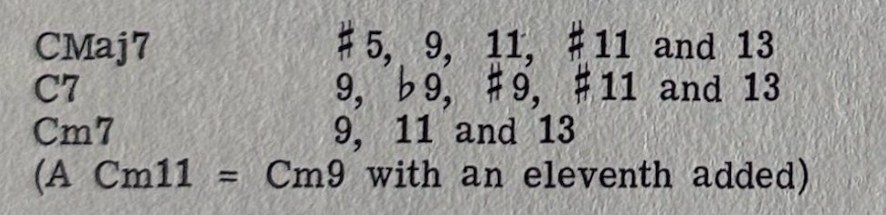
A few oddities include C+(Maj)7 which is C-E-G♯-B. C+(add9) is C-E-G♯-D. If you find chord symbols written as a fraction the bottom symbol is played in the bass and the top symbol in the treble (left and right hands). Here is an example Cm7F and C7G. The F and G are bass notes played with the accompanying chords in the right hand.
Just in case this list is a little confusing I hasten to say that beginners need only learn the major and minor triads, the major seventh, dominant seventh, minor seventh, augmented seventh, and diminished seventh. When you come across chords with 9th, 11th, or 13th intervals added just ignore them and play the appropriate seventh. All these more complicated chords can be studied later on.
There are two ways of finding the intervals which make up a chord. In the first method the notes of the major scale linked with the name of the chord are numbered, in order, so the intervals can be clearly seen. In the second method you do not need to know the notes of the scale. A system of working out the intervals by counting up in semitones from the root note of the chord you want makes this possible.
Let's take the second method first. It is very useful for ear players. The numbers of semitones for the intervals we will be using are:

Printed page 5


Counting up in semitones creates enharmonic problems in that the upward movement suggests that each black note should be a sharp when in fact most of them are flats. Numbering the notes of the scale as carried out in the first method is more exact.

Printed page 6

From any note on the piano you can find the chords you want by using the thumb and index finger to count up the semitones. Let's look at C chords again.
The best way of counting is to put the thumb of your right hand on C with your index finger on C sharp (one semitone); keeping the index finger on C sharp swivel the thumb to D (two semitones); keep thumb on D and swivel index finger to D sharp (three semitones). Keep going like this to count up the number of semitones needed for each interval in the chord required.
Suppose you want to find C minor seventh (Cm7). Look at the tables and you will read: Root to minor third (three semitones), root to fifth (seven semitones), root to minor seventh (ten semitones). Your Root is C. Three semitones up would normally be D sharp but as the minor third from C is a flattened third, the note, enharmonically, becomes E♭ instead. We now have C-E♭. Seven semitones from C to the fifth brings us to G. So far we have C-E♭-G-. Finally, the minor seventh, ten semitones up from C, takes us on to B♭. We now have the completed chord, C-E♭-G-B♭ (Cm7).
If you want to build up a chord on a black note, don't panic, just count the semitones up from whatever the root note is and you will get your chord.
You do not often have to play in sharp keys in jazz composition. G is the most likely candidate. It has one sharp, F sharp. However, chords like E7, A7, and D7 (which all have one sharp) sometimes appear in flat keys. In your chord building by semitone counting, a black note in C and the flat keys will be a flat rather than a sharp--with just a few exceptions. (One has occurred already, the G sharp in the C augmented chords.)
Numbered Scale System and Building Chords
Here is an explanation of numbered scale chord construction. This system is more satisfactory than the one already outlined. Counting semitones to build up chords does not lead to a better understanding of harmony. It is suitable for ear players but serious students will find the following technique more illuminating.
The scale of C major when numbered shows the intervals at a glance:

I have extended the scale beyond the C octave to cover intervals up to the thirteenth. Although I am limiting the general survey to chords of the seventh it is as well to see visually how the intervals above the seventh are placed.
C is number one as it is the keynote of the scale and simultaneously the root note of the chords we will be examining. You can see that D is a second, E a third, F a fourth, G a fifth, A a sixth and B a seventh, proceeding up to the thirteenth. Chords are built up in thirds (major or minor or combinations of both). In C major the thirds are:

In the first table you can see that 1 2 3 from C takes up to E; 1 2 3 from E goes to G and 1 2 3 from G comes to rest on B. I am sure you can follow this sequence on to the A above B which is the final third.
To make this quite clear you will remember that we built a triad with a third (major or minor) and the fifth (usually called the perfect fifth) which in effect is the joining of two thirds. Another third on top transforms the triad into a seventh. A further third adds a ninth and one more tops it with an eleventh while a final third creates a thirteenth chord. There is no point in adding any more thirds as they only duplicate intervals already used.
A major third becomes minor by lowering the third a semitone. We can diminish (flatten) or augment (sharpen) the fifth. "Diminished" and "augmented" are better than "flattened" or "sharpened" fifth be-
Printed page 7
cause they work in all keys. The major seventh can become a minor seventh by lowering it a semitone or diminished by being lowered two semitones. In C a minor third (m3) would be E♭; a diminished fifth (o5)--G♭; an augmented fifth (+5 or ♯5)--G♯; a minor seventh (m7)--B♭ and a diminished seventh--A (B double flat).
The method for finding intervals and chords is the same in all keys. As long as you know the major scale for the root of the chord you will have no problems. Number the notes of the scale in order from the tonic and then you can work out the appropriate intervals for the chord you want in the same way that I have demonstrated in the key of C.
Supposing you wanted to know what the intervals were for F+7. Find F Major in the chart then look at the bottom section which gives the intervals for the chords we are building: + means augmented. Read the description for Augmented Seventh: Root-third-augmented fifth-minor seventh (1-3-+5-m7). Go back to the F Major scale. 1 is F; 3 is A; 5 is C so +5 (raising it by a semitone) is C♯; 7 is E therefore m7 (minor seventh) instructs you to lower the note by half a tone which alters E to E♭. We now have all the intervals we want: F-A-C♯-E♭ (F+7). Note that +7 is a simplified symbol for a dominant seventh with a ♯5.
As you can see I have spelled out all the chords you will need on my chart. However, I do advise you to work out some of them yourselves using the numbered scales plus the list of intervals. As you learn all the scales by heart in time you will be able to number them in your mind as you visually scan the keyboard. You will then be able to work out your chord symbols without reference to charts and the process ultimately will become a spontaneous routine leading on to a complete recollection of all chords in all keys.
Building chords using the numbered scale system produces two instances where the expected chords are slightly different from the usual pattern.
The Fourths and Fifths built on the notes of a major scale are called "Perfect" with the exception of the Fourth built on the fourth note of the scale and the Fifth formed on the seventh note. The Fourth in this case is augmented as it measures six semitones instead of five. The Fifth is diminished because it is a semitone less--six instead of seven semitones.
In the key of C major the augmented fourth is from F to B (four notes) and the diminished fifth from B to F (five notes). These intervals are tritones. Although they are the same size (six semitones each) they have different names because intervals are usually calculated by counting from one note to another.
If you wanted a Perfect Fourth from F five semitones up would take you to B♭. A Perfect Fifth from B (seven semitones) would take you to F♯. These intervals are not diatonic as far as the key of C is concerned so both B♭ and F♯ are accidentals.
Chord Books and Musical Form
When chord symbols are written out on manuscript paper the number of beats to each measure is indicated by diagonal lines. In 4/4 time (four beats to a bar: each beat having the value of a crotchet) a chord symbol over the first of four diagonal lines means that the chord lasts for the four beats (A). A chord symbol over the first diagonal line with a different one over the third line shows that each chord lasts for two beats (B). There can be a chord for each beat in a measure (C) or a chord can be displaced with three beats for the first chord and one beat for the second chord (D).

In musicians' chord books where the chords are written out in a series of squares the diagonal lines are either abbreviated to diagonal or horizontal dashes or not given at all (E).
If there are two chords to a measure with two beats each or one chord covering four beats it is not necessary to fill in the dashes as the number of beats to each chord is self-evident (F).
The greater majority of jazz evergreens are compositions of 32 bars duration. The thirty-two bars can be two sections of 16 bars each or an eight bar section which is repeated once then followed by what is called a "middle-eight" (bars) and then stated again to complete the 32 bars.
There are abbreviations to show these different song forms. If the two sixteen bar themes are
Printed page 8
Printed page 9

Printed page 10

clearly different you can assign "A" to one and "B" to the other. When the chord symbols are written out in squares, the "A" and "B" can be written in front of each of the sixteen squares to make the form clear before the chords are played. You would find "AB" written above the chord squares plus the key name.

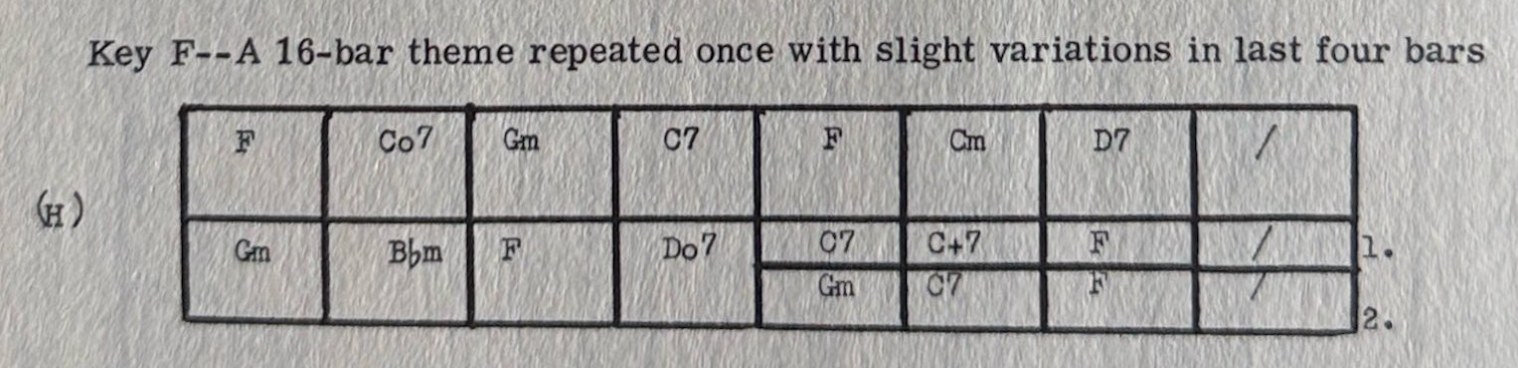
If you do not want to write out the 32 bars in full you can reduce the number of the chord symbol squares by half (H). The "1" and "2" show the chord variations in the last four bars of each sixteen. After the chord in the twelfth bar is played (Do7), proceed through the four bars marked "1" then go back to the beginning playing again up to the Do7 chord and then work through the four bars numbered "2." The two sequences of sixteen bars have now been completed and the 32 bars fully covered.
In the case of the eight bar sections which include a middle-eight, the first eight bars are labelled "A" and the eight bars called the "middle-eight" are classified as "B." This form of composition is referred to as AABA because the "A" section is played three times and the "B" section just once in each thirty-two bars.
In the "AABA" chord sequence you can either write it out in full or reduce it to a statement of the "A" section and "B" section. The first repeat of the "A" section is usually slightly different in the last two bars so that a suitable modulating chord can be inserted for a comfortable move into the middle eight bars. In (G) I have given an example where the last two bars of the first eight bar theme vary a little. Each eight bars
Printed page 11
are marked "A" and "B." If "AABA" is put above it with the name of the key it instructs that the "A" section should be played twice, the "B" section once, followed by a restatement of the "A" theme to complete the 32 bars.
Strictly speaking the final (thirty-second) chord should finish on the tonic chord of the chosen key. However, when a number of choruses are played the last eight bars are more or less the same as the first eight.
You will notice in (G) the dashes in bars two and three. These indicate that the last chord shown should be repeated for as many bars as have these dashes. In this example it is the F chord which is repeated twice.
In many traditional jazz compositions there are a number of sections before the chorus. Clear instructions are needed in the chord book. There might be, for instance, two themes of sixteen bars before a sixteen-bar chorus. This could be labelled, "ABC stay on C." Sometimes introductory themes are to be played twice before the chorus. This could be written down as "2A2BC stay on C." The identifying letters must be written at the side of the appropriate bars in the manner shown in (G). Occasionally you will find a four-bar bridge between verse and chorus; this needs to be marked "Bridge" to visually make it clear what is happening otherwise it might appear that the four bars were a part of the verse rather than a separate musical statement.
In (I) I have shown a method I have worked out to remind me of the melody for tunes in my chord book which I have not played for a long time and may not be played again in the immediate future. It is also helpful where a middle-eight is difficult to remember. I have written out the melody in lower case lettering so that it is not mixed up with the chord symbols which are in capital letters. It must be assumed that the melody is to be played in its correct key so that a "b" in a B flat key is B flat and not B natural. If the key were D flat it avoids putting in all those flat signs. Nonetheless the odd sharp or flat will have to be inserted now and again.

Obviously the time value of each note cannot be given. As the original melody has only been temporarily forgotten the notes given in each square will in most cases be a sufficient reminder of what to play. It is useful too to put the starting note of the theme in the first square especially if it is an unusual one.
The form in traditional, mainstream and early bop kept more or less to the AABA, ABC, and AABBC patterns. From the Sixties onwards composers (especially in pop music) became more venturesome breaking away from the AABA formula into more extensive variations like ABABCAB and ABACA.
How To Use Chord Symbols With a Melody Line
I have written out a theme of four measures to help explain what to do with chord symbols when a top line melody is given. In Example (A) it is clear that each chord covers two beats except the final C Major Seventh. Build up the chords given by using one of the systems outlined. When this has been carried out check with the chords shown in Example (D) to see if your calculations are correct.
I have placed the chord symbols above the melody line. They can be written underneath, it is a matter of taste, but if there had been a lyric written under the staff lines there would not have been room for chord symbols as well.
To encourage ear players I have given the names of the notes of the melody and indicated the value of each note by counting the beats in each measure: 4/4 time is 4 beats to the bar; the value of each beat is a crotchet.
The single black notes on one stem are crotchets; those joined together are quavers which are half the value of a crotchet. There are four beats to a bar (measure), one for each crotchet, 1-2-3-4. As two
Printed page 12

Printed page 13
quavers equal a crotchet we can count them as, "one-and." To avoid mixing up single beats with the "one-and" we can beat in both crotchets and pairs of quavers as, "one-and." This can be abbreviated to, 1A-2A-3A-4A. Have a look at Example (B) to see how various permutations of crotchets and quavers are counted. The open headed note in the last measure is a minim: it lasts twice as long as a crotchet which is why I have put, "3A4A" below it to show that it covers two whole beats.
Note values are related to the semibreve. A semibreve is a whole note like the one placed in bar four of Example (A). It is logically the basis of quadruple time. A minim is a half-note (two minims to a measure); a crotchet is a quarter-note (four crotchets to a measure); a quaver is an eighth-note (eight quavers to a measure). These divisions assume that we are thinking in 4/4 time. A quaver on its own has a curly tail called a flag. Flags indicate the time values of notes with black heads. In groups, the quaver is sometimes joined to its neighboring quaver by a line called a beam. Four quavers can be joined up provided the number of beats in the bar is not made less clear visually by doing so, Example (C).
Non-readers should now be able to follow the four-bar theme without much difficulty provided they have managed to build up the chords. To encourage them to have a go at reading I have named the lines and spaces in Example (H).
Some beginners are bewildered by chord symbols. In spite of their being able to read a simple melody they cannot work out what should be done to amalgamate chord and melody.
All the chords in the four-bar theme are sevenths of some kind (D). If each chord is spread out and shared between left and right hands an attractive sound can be created. The basic method of doing this is to play the root and seventh note in the left hand and the third and fifth in the right.
The first bar included CΔ7 and Fm7. For CΔ7 play C and B in the left hand and E and G in the right. The voicing for Fm7 would be to play F and E♭ in the left hand with A♭ and C in the right.
Work out the other chords in a similar way. Arranging the chords to be spread out between left and right hands makes a simple accompaniment to another instrument playing the melody (E).
If the pianist wants to play the melody he can use the same chord voicing written out in Example (E) adding the melody note above the top note of the interval in the right hand. This works out happily with all the chords except the G7 in the third measure. Its fifth being higher than the melody note, B natural. All that is needed is a little adjustment in the right hand notes. Use a G and the melody note above it, B natural. Both these notes belong to the G7 chord. Rearrangement of the right hand intervals may be necessary when the melody note is in an awkward position. Notes can be added or left out or a different inversion used. But whatever you do must relate to the chord in question Example (F).
In bop and modern jazz intervals of the ninth, eleventh, and thirteenth are often added to basic sevenths. In Example (G) I have added an eleventh (B♭) to the Fm7; a ninth (F♯) to the Em7 and a ninth (F♮) to the E♭7. A ninth (E♮) has been added to the Dm7 and a thirteenth (E♮) to the G7. In the final bar there is a ninth (D♮) to give the sound of the chord a bite.
How To Work Out a Piano Accompaniment From Chord Symbols
To round off the study of chord symbols we will see what can be done when a set of chord symbols has to be converted into an accompaniment.
The jazz pianist will sometimes be asked to run through just the chord symbols of a tune that he has not played before or even heard played by someone else.
When you are given a set of chord symbols without a top line melody there are a few precautions to be taken to avoid making a mess of how you read them. First of all note the key signature, then find out the form. Is it, AABA, AABC, AB, or one of those dixieland classics with an arrangement of sections like 2A-2B-Bridge-Stay on C; or maybe it is another variation of form? It is important to find this out before you start otherwise you may find you get out of phase with the front line.
Note the length of each section as there are some occasions when one of the sections has an unexpected number of bars and unless you are aware of this feature before you start playing you will come to grief. To give just a few examples of AABA numbers with extra bars there is "Midnight Sun" with an A section of fourteen bars and a B with eight. In "Wave" the A section has twelve bars and the B eight. You will find sixteen bars for A and nine bars for B in "Call Me." Sometimes the A section has fewer bars. The A in "Moonlight In Vermont" has six. In the dixieland classic, "Ja Da," both the A and B sections are only four bars long so the total number of bars for the AABA is just sixteen. Added to this there is a two-bar tag at the end of each chorus. Be careful, too, about blues, especially the older ones. Both, "Trouble In Mind" and "How Long Blues" are eight-bar blues and not the expected twelve.
Printed page 14
If the form is understood you will be able to express the chords in a more intelligent way. When you play a solo it will help you to improvise on the chords so that what you play fits the shape of the actual melody even though you may not be familiar with it.
As the pianist will not be called upon to solo straightaway he should listen carefully to what the front line plays so he can get some idea of what the piece is all about.
To show what can be done with straight chord symbols I have chosen two four-bar sequences to work on. The first example can be found in many traditional jazz numbers. The second set of chords has turned up in at least three standard evergreens. Build your chords from one of the systems already explained (Example A). Experiment with the inversions as some sound better than others. For beginners, this means that in a dominant seventh, for example (Root-third-fifth-minor seventh), you move the root up to the top end of the chord. You will then have, Third-fifth-minor seventh-root for the first inversion. For the second inversion place the third at the top of the chord to arrive at Fifth-minor seventh-root-third. The fifth is moved up for the third inversion.

I have added a sixth to the B flat chord in Example A1 to give it more body. The seventh chords do not need any extra intervals in a traditional jazz number.
The left hand bass notes can be single notes or octaves according to taste. The first beat in the bar is usually on the root note of the appropriate chord. It is played in the left hand. The second beat is a chord in the right hand. The third beat, in the left hand, is on the fifth note of the chord. The fourth beat is made with a chord in the right hand. The bass line would be, Root-fifth-root-fifth. See A1. Note that it is sometimes acceptable to reverse the bass line to Fifth-root instead of Root-fifth. See A1 bar 4.
If there are two different chords to a bar, play the root note of each chord in the left hand at the same time as you play the chord in the right hand. See B1. Alternatively you can play Root-chord-root-chord playing the root notes in the left hand and the chords in the right hand in the manner shown in A1.
A bass line can be played as a melodic pattern relating to the notes of the chord. Traditional jazz musicians sometimes like the pianist to play a chord to a beat in the right hand to give a strumming banjo effect. This can give a good background to a trumpet solo. Don't overdo this; it can be a bit monotonous (See A2).
The right hand in A3 is played against sustained three note tenths in the left hand. If you have small hands play an octave on the root note or you could use root and minor seventh as left hand support.
In Example B the chord sequence can be attractive in a slow tempo. The single notes in B1 are all root notes of the chords. Inversions are used in four out of the eight chords to get a better sound. There are three note tenths in the left hand in B2 which make the voicing more melodic. In B3 the right hand chords are broken up into intervals; root and fifth and third and minor seventh. I have done this to add variety. The experienced pianist will alter the pattern of his accompaniment now and again as long as it is not out of character with the piece being performed. This is not to say that there should be a lot of style changes within one number. This could upset the front line. However, an occasional change of accompaniment style can be stimulating to the other players and set new ideas going. Bass players and more thoughtful members of the front line do not always like to hear a pianist playing an improvised solo all the time behind their solos. An accurate accompaniment with the bass player (and guitarist, if there is one) playing the same chords is a much more supportive background.
To end this survey I must warn all beginners to look out for wrong chords. Unfortunately, chord symbols on song copies are not always as accurate as they should be. They can be over-simplified and to add further confusion passing chords may be present so that it needs some working out to sift these from the main chords. When playing a song copy, a chord can be checked if it sounds doubtful by reading the music and building up a chord from the combination of left and right hand notes. You can then compare what you have worked out with the written chord symbol and make any necessary adjustment.
If you are building up a collection of chord sequences of jazz numbers you want to play by copying out what musicians have got in their chord books, try to check them with further entries of the same numbers in other books as they may be incorrect. Sets of chords can be passed around many times before somebody realizes that they are not workable. The trouble originates from some player way back in time who worked out the chords by listening to a record and got it all wrong through a poor ear and a lack of knowledge of harmony.
Printed page 15

Printed page 16
In the examples A1 to B3 I have covered different accompaniment styles from a rather old-fashioned Oom-Pah-Oom-Pah in A1 to something with more space in B2. All these examples are basic approaches which need to be adjusted and polished in practice. In more modern kinds of accompaniment