Circle of Fifths
The circle of fifths is the circular clockwise or anti-clockwise movement of the twelve keys which are formed by building new scales a perfect fifth (seven semitones) above or below middle C. Each new key starts a fifth from the tonic note of the previous key. Ascending, C goes to G then D and A and so on through all the sharp keys. Descending, C goes to F, B♭, then E♭ and right through all the flat keys. It is considered a circular movement as whichever way you proceed you must ultimately return to C.
In jazz we think of the circle of fifths mainly as a downward movement of dominant or minor sevenths or a combination of both. It can be said that there is a strong tendency for the root of a chord to move down a perfect fifth. A C chord seems to be drawn towards an F and in turn an F chord is attracted to a B♭ chord.
A circle movement can begin on any chord. II-V-I is a circular movement; it need not be more complicated than that. Longer circles usually start at the beginning of a phrase; shorter ones can appear anywhere as long as they do not clash with the natural progress of the tune being played. They can be used to fill in rest bars or to bridge from one phrase to another. The circle can move, say, from C to D♭ in fifths but shorter sequences, like D to G to C are the norm. The harmonic construction of a number does not always allow the improviser to introduce long sequences of circle movements.

As far as jazz is concerned, the circle of fifths came into its own with the emergence of Bop. It has no real importance in traditional or dixieland harmony where its occasional appearance is incidental. The nature of these early styles makes circle introduction out of place in improvisation. However, the circle can effectively be used with mainstream numbers and more recent forms of popular music where the harmonic construction lends itself to this kind of chord movement.
There are quite a few mainstream numbers with middle eight bars made up in circles of dominant sevenths like: D7/-/G7/-/C7/-/F7/-. You can alter the sound of these bars by placing a minor seventh in the II position before each dominant seventh (Am7/D7/Dm7/G7, etc.) arranging your inversions of the chords to keep the sequence fairly compact so that your left hand is not jumping about all over the place. Alternatively, you could try out a whole step circle of II-V chords. As the chord in the last bar of the above middle eight is F7 (to lead into a B♭ chord on the last eight bars) we want to arrive at this chord although we will take a different route. Find the II chord of F7: this is Cm7. From here, in whole steps, work back from Cm7 to the first minor seventh of the eight bars. As we are starting from the wrong end we actually go forward in whole steps: Cm7 to Dm7, Em7 and F♯m7. Now find the dominant seventh for each of these II chords. Allowing a bar for each chord you will now have (in the right order this time): F♯m7/B7/Em7/-/A7/Dm7/G7/Cm7/F7. The original melody of your middle eight would have to be adjusted to align with these chord changes. You might even need to create a new melody line. Remember that each II-V represents a fragmented key change which because of its brevity is theoretical rather than a reality.
To summarize, the circle of fifths in jazz is found in four forms with occasional variations such as using half diminished chords instead of minor sevenths or mixing up the kinds of chords lined up in fifths.
The four basic forms
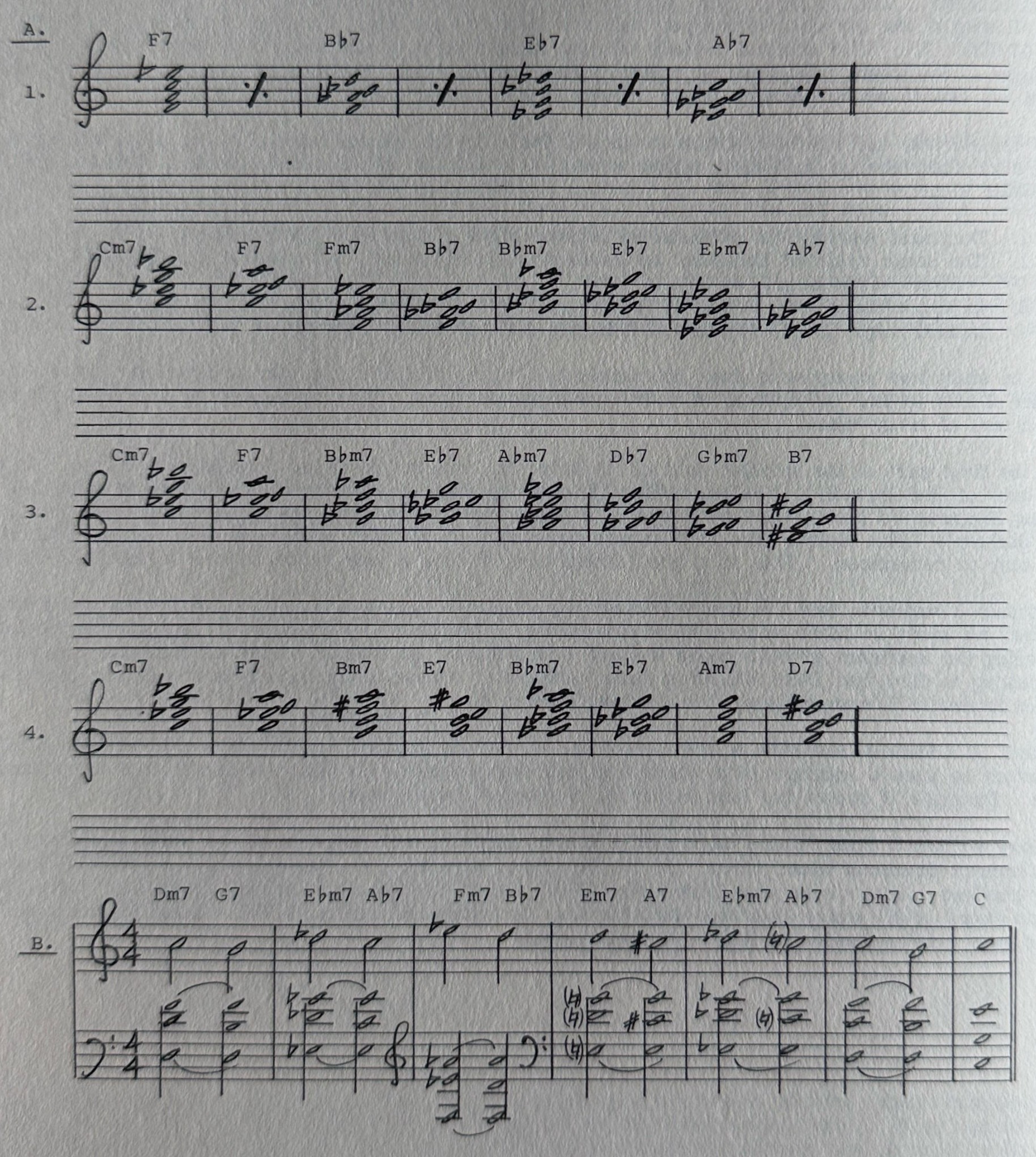
- Dominant sevenths in patterns of perfect fifths (e.g., F7/-/B♭7/-/E♭7/-/A♭7/-).
- The same cycle of dominant sevenths preceded by minor sevenths (e.g., Cm7/F7/Fm7/B♭7/B♭m7/E♭7/E♭m7/A♭7).
- In whole steps (e.g., Cm7/F7/B♭m7/E♭7/A♭m7/D♭7/G♭m7/B7).
- In half steps (Cm7/F7/Bm7/E7/B♭m7/E♭7/Am7/D7) Example A.
If you study how composers have introduced the circle of fifths into jazz and popular music it will give you an idea of how to use the system in your own improvisations. The circle appears naturally in the harmonic structure of many tunes.
In the first part of the middle eight of "A Night In Tunisia" there is a whole step circle. In the middle eight bars of Bud Powell’s, "Hallucinations" the whole steps are confined to a bar each of a II-V sequence. "Everything Happens To Me" makes good use of a short circle movement (II-V-I) shifting down half a tone. In Kenny Dorham’s "Blue Bossa" the first twelve bars contain a circle movement going down in fifths which makes it easy to remember. This is a good illustration of how a long sequence can be used effectively.
Although I maintain that the circle had no importance in pre-Bop jazz the chord changes of numbers like, "Shine" all move in fifths ending up with a circle of four bars. The more recent use of the minor seventh preceding the dominant gives a more modern sound which the earlier series of dominant sevenths lacked. It is interesting to find that Duke Ellington quite deliberately chose a circle movement for the four bar piano introduction to his 1931 composition, "Rocking In Rhythm."
There is a famous instance of the use of the circle of fifths in Art Tatum’s 1939 version of "Tea For Two" in which he uses a mixture of a whole and half step sequence in what seemed then a unique and exciting innovation. Example B shows the kind of circle movement Tatum used.
I have written a blues which uses circle movements to break away from the basic simplicity of the tonic-subdominant-dominant blues form. It can be played at a slow or fast tempo. In bars five and six I have used rootless minor ninths and thirteenths (II-V): see "Left-Hand Patterns," page 62. Note that B7 is a substitute chord of F7 which indicates that the last two bars are really II-V-I. Many jazzmen use the chord changes in bars nine to twelve to finish off their solos.
Battersea Blues
