Composite Chords
Chords are built up from combinations of major and minor thirds. A major third joined to a minor third forms a major triad (Root-third and Fifth). Add to that another minor third and you will have made a dominant seventh. The addition of a major third produces a ninth; add on a minor third to get an eleventh. If you carry on with a major third you then have a thirteenth.
Building on the root note of C you would get a sequence of: C-E-G-B♭-D-F-A (R-3-4-♭7-9-11-13). Adding intervals above the seventh gives a bite to the chords so formed. As the whole movement of modern jazz from Bop to the weird sounds produced by contemporary groups includes harmonies with these extended intervals, it is useful to have a formula to quickly find chords with intervals of the 9th, 11th, and 13th. Composite Chords is a system for building up these chords. Basically you play one chord in the left hand (usually a dominant or minor seventh) while sounding a different chord in your right hand. The right hand chord includes one or more of the three extended intervals of the 9th, 11th, or 13th. They can be raised or lowered. The possible combinations are considerable.
Books on jazz harmony often stipulate that intervals extended above the seventh are only valid if you get the combinations right. There is some degree of doubt about what is correct because different writers tend to give opposing instructions. For instance you may find in one manual that you should play a ninth with a thirteenth whereas another book would not insist on this. It is sometimes said that an eleventh does not fit in with a dominant seventh unless it is augmented. There are other controversial rules which say that a thirteenth can only appear with a dominant seventh, arguing that with a minor seventh a "thirteenth" is really a sixth. I suppose in a sense that is true but if the chord is voiced with a "thirteenth" extended above the minor seventh it seems to me that it is more thirteenth than sixth.
My personal opinion is that you can use whatever extended intervals you like built up on dominant, minor, diminished, half-diminished, and augmented sevenths as long as the sound produced fits in with what you wish to say and does not offend your ear.
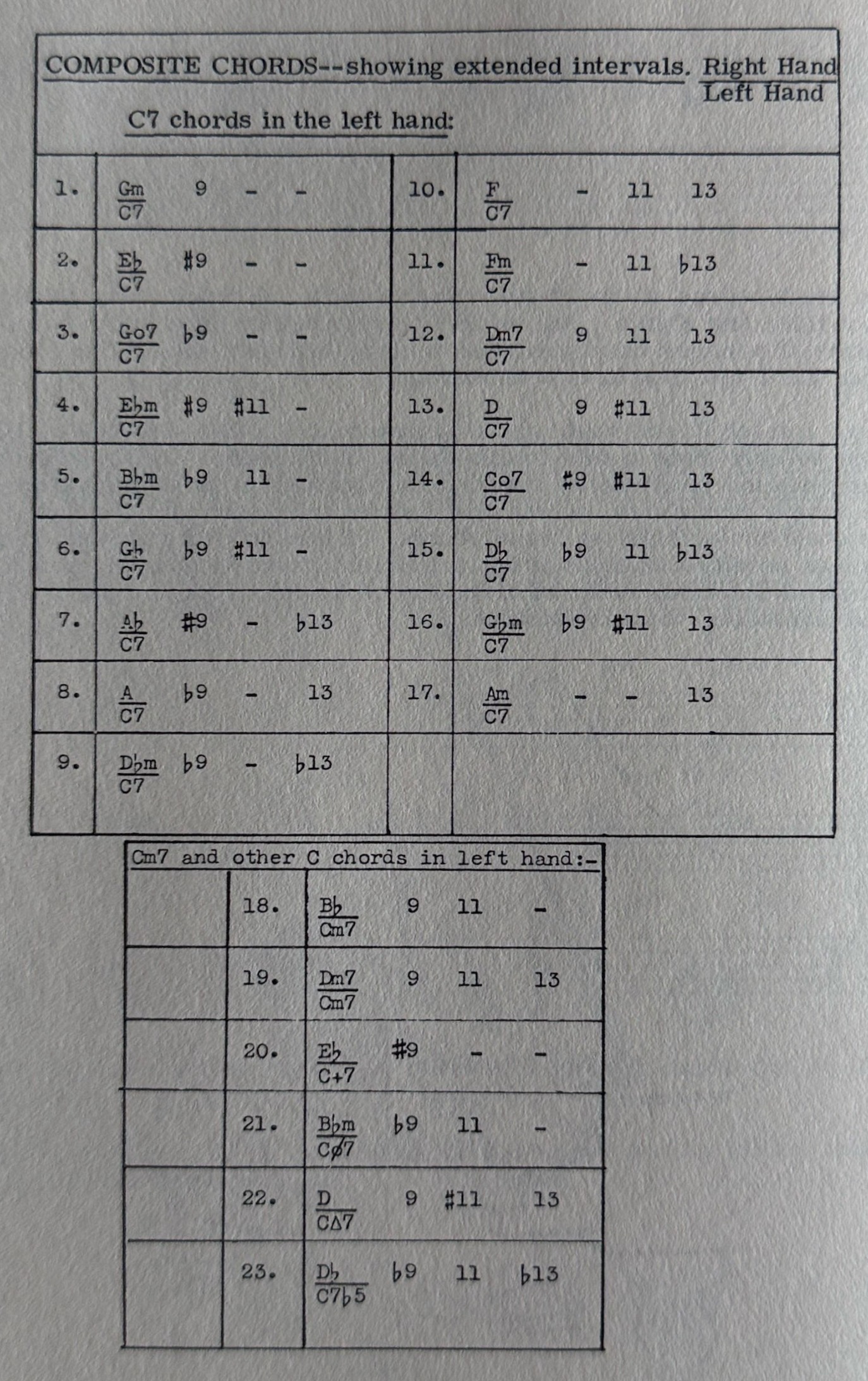
Building Composite Chords
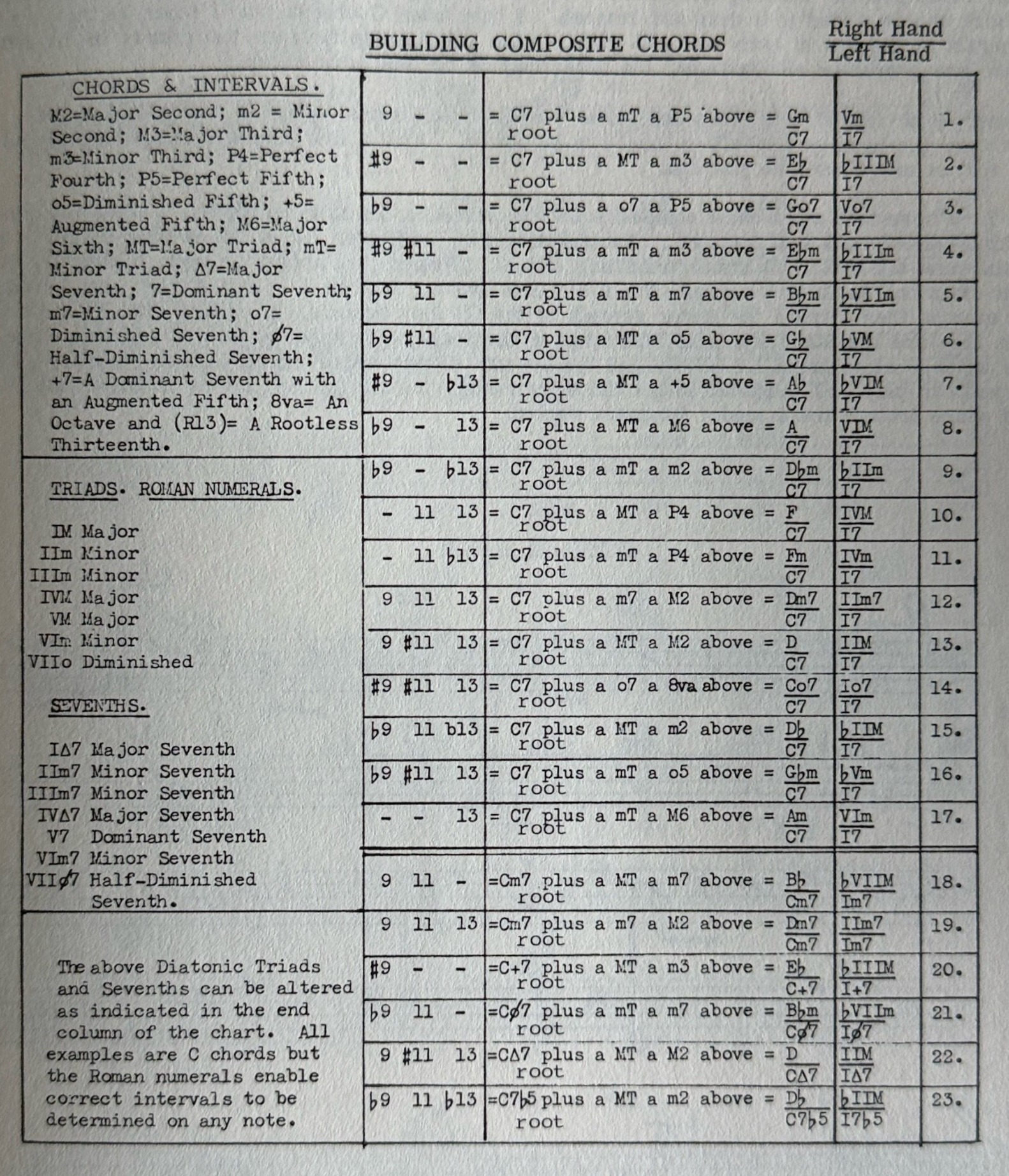
If you wanted to find the composite chord in, say, Example 12 for F you need to think in the scale of F. So I7 would be F7 in the scale of F and IIm7 would be Gm7 making a composite chord of F7 in the left hand and Gm7 in the right. The Roman numerals refer to the Diatonic scale of the name of the chord with any alterations indicated for the chord required.
Note: Normally Roman Numerals do not have the quality of the chord added to them unless they are non-Diatonic. I have added the quality symbols above to differentiate between triads and sevenths. In the section on "Chords & Intervals" note that M2 is a whole tone and m2 is a semitone (a Major and minor Second).
In the chart headed "Building Composite Chords," reading from left to right, you can see the extended intervals which can be added to a dominant seventh. I have used C chords but if other chords are needed the Roman numerals at the end of each row will give you the relationship between the chords in the left and right hand. These are expressed as fractions, the lower half is the left hand chord.
It must be obvious that to learn composite chords for all notes would be a formidable task. I have listed more than you need so that all of them can be tested. Find a few combinations which appeal to you and learn them for as many notes as you can.
The first seventeen rows show composite chords based on dominant sevenths. The remaining chords are other kinds of sevenths you may use. The fraction with Dm7 over C7 is the easiest example to show how these combinations are built. D minor triad is: D-F-A. Played just above the root of the C7 (the other chord in the fraction) the D is a second, the F a fourth and the A a sixth. But if they are moved up an octave which extends them beyond the minor seventh of the C7 they become, in order, 9th, 11th, and 13th. In other words they are the 9th, 11th, and 13th notes in the scale of C Major. As you can see these three notes make up a D minor triad. I have added the seventh to this minor chord because it makes the sound richer but you can play just the triad to get those intervals. So all the top chords in the fractions are made up of notes which include the extended intervals wanted.
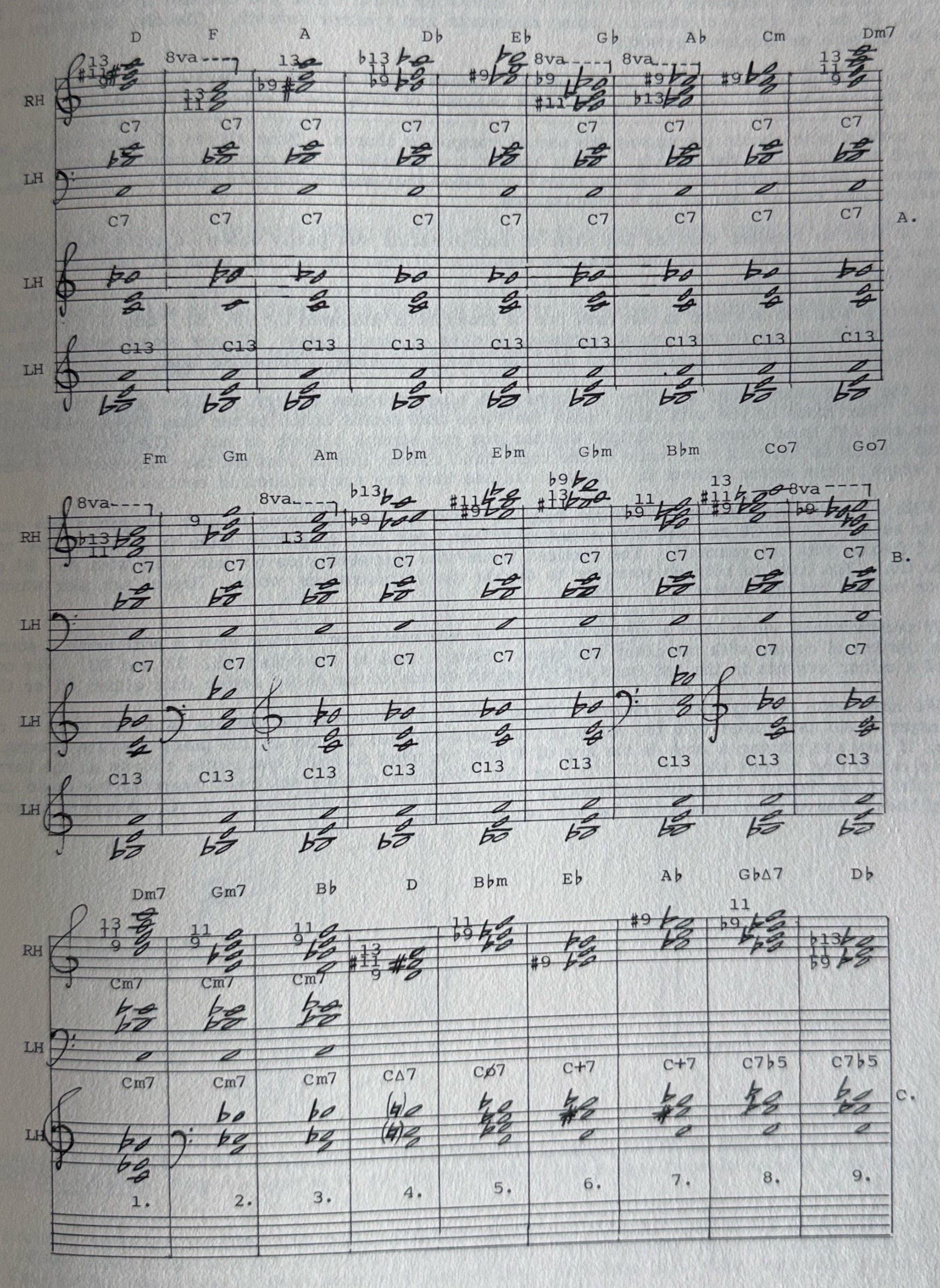
The smaller chart will, perhaps, be easier to follow when you decide to try out some chords. I suggest that the following Composite Chords have an interesting sound which you can use in your solos: 7, 8, 10, 12, 13, 17 and 18 for a combination using dominants and a minor seventh. Clearly, there are more selections to be built on dominant sevenths.
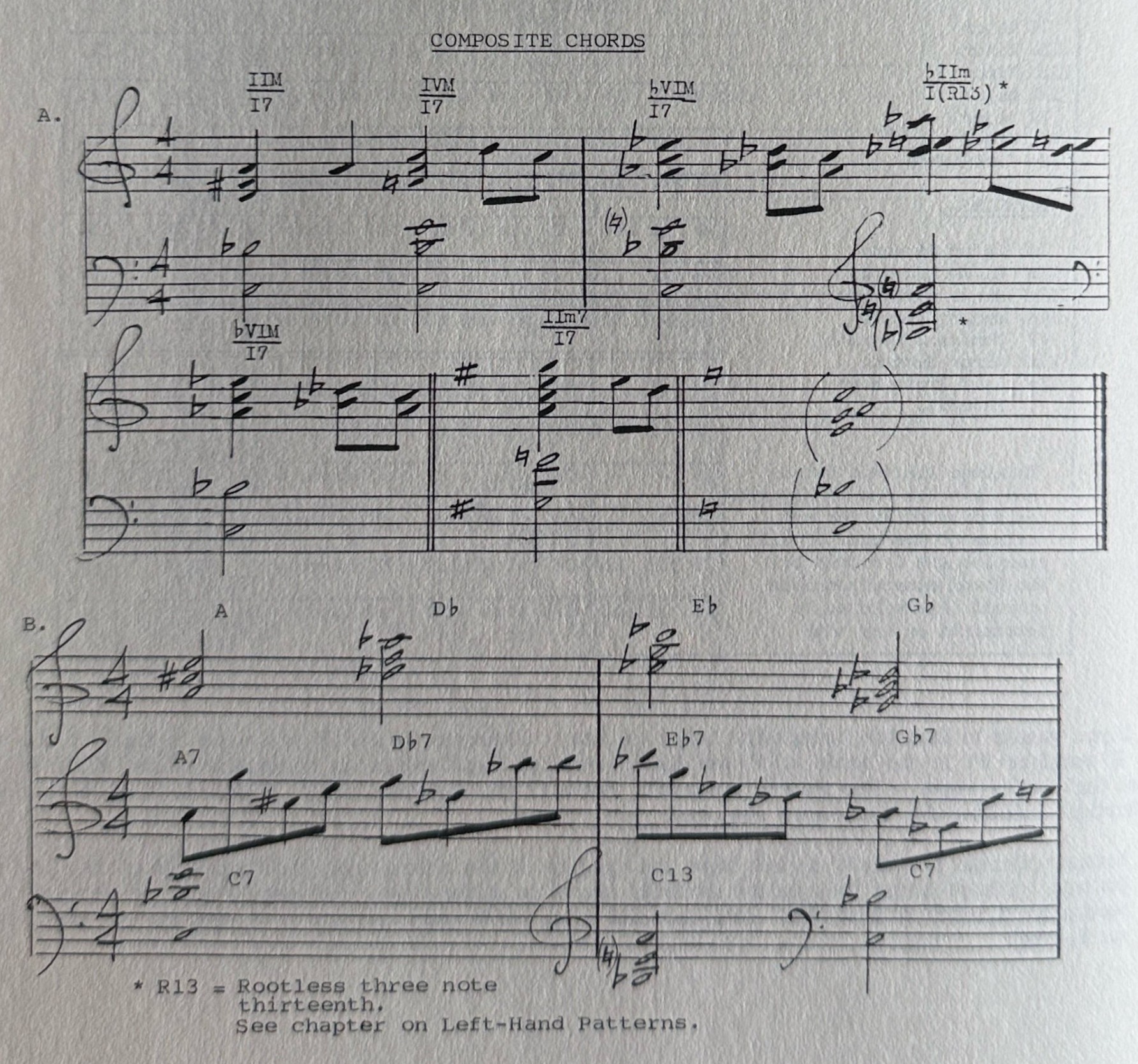
If you have practiced some of the Composite Chords listed but are wondering what on earth you can do with them the four-bar musical example will show one way of using these chords (Example A).
A melody note should accompany the use of composite chords. Your choice of chord will be determined by how well it blends with the melody. These chords can be used to get more interesting sounds in piano accompaniment. As they are chords spread over both hands they will be easy to handle. Composite chords without a melody line can be used as an accompaniment.
It is well to consider that the Bop style of improvisation was partly based on using these extended intervals in the melody line. It is interesting to sustain a C7 chord in the left hand and play the single notes from the right hand chords.
Starting with the A chord in the first bar of Example B (followed by D♭, E♭, and G♭) you will see the extended intervals can be formed into a continuous pattern of single notes. Triads sound better than dominant sevenths as chords but single note patterns need the seventh to make a smoother line.
In the main chart there are three sections with nine examples in each. I have given three different left hands. For those of you with large hands the three note tenths sound better than the smaller chords. The other two left hand chords are alright whether you can stretch a tenth or not. The rootless three-note thirteenth chords do not mix with some of the right hand chords; this is because the "thirteenth" is added to a chord which works better without it. As you can see they are not included in section C.
With so many combinations to choose from it would be less confusing to pick out just a few examples. Chords in section C4 to C9 are not very satisfactory but I felt that by putting them in it would give you the chance of finding this out yourself. The rootless three-note thirteenths do not mix well with A4, B1 or B5 or C1 to C3. You have to rely on your ear to decide what combinations work. Reject any pair which lacks clarity or sounds too discordant.
If combinations which give a ninth, eleventh, or thirteenth are tackled first it will make a start and reduce the burden of coping with too many varieties. Have a look at Examples A9, B2 and B3. For one example of a minor seventh in the left hand try C3 which seems to me to be better than either C1 or C2.
We have been dealing with C chords. When other chords are to be tackled each one must be related to the major scale associated with the name of the chord and not the key of the piece you are playing. For instance, if you are playing a tune in the key of F and you want to build composite chords on the harmony given you might find chords like, F, C7, D7, or G7. Working out the extended intervals for these chords with the aid of the Roman numerals will require your calculating in the keys of F, C, D and G Major. The names of these chords are keynotes of the appropriate scales.