How to Harmonise a Simple Melody
Part One - How to harmonise
If you compose a melody and wish to harmonize it you need to know the function of chords and some basic rules to guide you.
I covered some of the rules in Diatonic Harmony, Circle Of Fifths, Chromatic Chord Movements, and Composite Chords.
To understand chord functions they need to be expressed in Roman Numerals. The II–V movement appears in all compositions. It is an important basic chord sequence. As there are so many brief key changes in all tunes this II–V movement is not always noticed. It does not always resolve to the I chord of the key in operation any more than the temporary dominants lead to their temporary tonics in every case.
Basic harmony involves circle movements of chords all making their way back to the I chord, often altering their course before they get there. The III–VI–II–V–I sequence is sometimes used. The III chord moving towards the VI which in turn is attracted to the II chord inexorably linked with the V leading on to the I chord. II–V movements fit in more neatly than the longer sequence starting with III; it depends on the melody line.
In simple melodies without chromatic notes the diatonic chords can supply the harmony without much trouble. However, this may work out for four bars or so but then the melody may take an unexpected turn where different harmonic systems would be more suitable. It may be that a chromatic chord sequence could be used or the addition of a substitute chord would help.
Find out what key your piece is in before you start to work out the harmony. Run through the diatonic sevenths and experiment with the basic chord movements like: III–VI–II–V–I and I–II–III–IV. The next thing to do is to examine the melody line and see whether groups of notes fit into any of the diatonic chords of the scale being used. Remember that combinations of diatonic chords make circle movements. Chromatic chords are the ones built on non-diatonic notes.
We are going to harmonize the theme in Example 1. All the notes in the first four bars are a part of the diatonic scale in F major. Clearly, diatonic chords will fit this part of the melody. The first three notes A–A–C could be part of an A minor or F major chord. The remaining four notes in bar one look like a G minor. If we assume that the first chord is an A minor (the notes suggested this) in the key of F this would make it a III chord. The III–VI–II–V circle movement would fit here allowing a beat for each chord. In fact this sequence is suitable for the second and third bars as well. The fourth bar returns to the tonic note F which needs an F chord to back it. So far our chords will be: Am7 Dm7 Gm7 C7 / Am7 Dm7 Gm7 C7 / Am7 Dm7 Gm7 C7 / F – – – /. I have not added the chord symbols we have worked out to Example 1 so we can think more carefully about what we are doing.
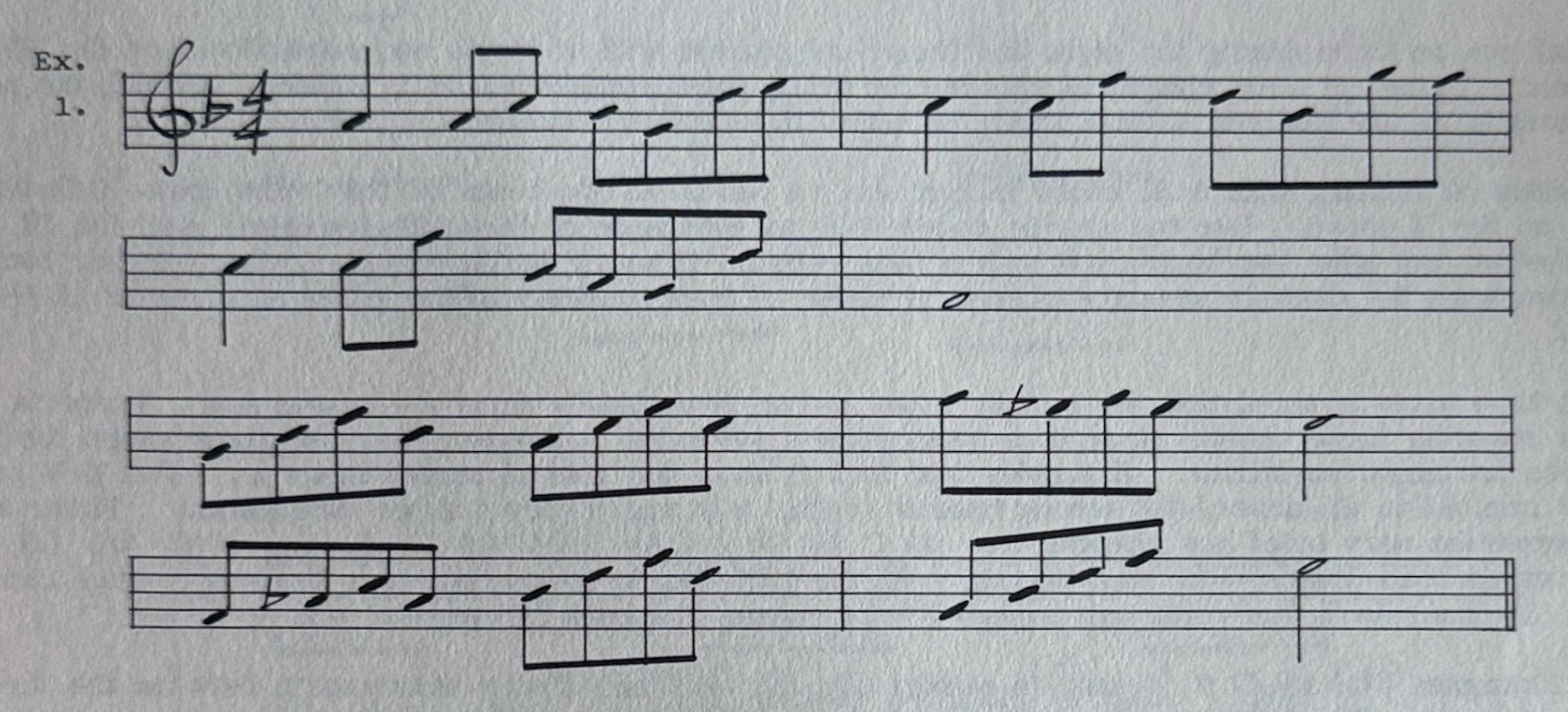
There are too many chords in the first three bars to be comfortable. When we have a second look at our harmony we will try to find a method which uses fewer chords.
There are still four bars to harmonize to complete the trial run. The notes in bar five spell out a G minor and an A minor but bar six presents a different problem. The melody has moved out of F into another key.
If a key change is not too clear have a look at the next bar to see whether a sequence there can logically be connected with its preceding bar. The notes in bar seven seem to suggest an F minor and a B♭ Major chord which would place that bar in the key of E♭. Bar six would work with 2 beats each on E♭7 and A♭7 but these chords do not move smoothly from the chords in bar five or link up happily with the chords in bar seven. The melody notes in bar six could suggest an F7 chord (the C, F, and E♭) but again this does not link up with the bars on either side. We must look elsewhere for a solution.
The diatonic sevenths in the key of F major show that the chord following Am7 would be B♭△7. The E♭ in the melody would not match this chord, but it can be avoided if the B♭△ is altered to become a minor seventh. The four quavers in the melody blend with a B♭m7 but the C needs another chord. If the B♭m7 is a II chord of the key of A♭ major the V chord would be E♭7 which does not do anything to help the C melody note. But if the II chord moves to the I chord diatonically the melody would fit. We therefore have two beats of B♭m7 and two of A♭△7.
How can the last sequence connect with the Fm7 in bar seven? There is a method of modulating from one key to another by taking an inversion of a chord where that inversion forms a II chord in the new key. The A♭△7 can turn into an Fm7 chord if you take the third inversion (G–A♭–C–E♭) which is actually an Fm9 without its root note. So we have made the jump from A♭△7 to Fm7(9) which is extended to cover the first two beats in bar seven to lead on to the B♭7.
The final bar is clearly Gm7 (the melody notes belong to this chord) which as a II chord leads to C7 and so we can turn around and arrive at the opening chord of bar one. The chords for the last two bars are Fm7 B♭7 / Gm7 C7 which represent a fragmented whole-tone circle movement. An E7 or E+7 could logically lead into the opening bar. Another alternative would be to use an A♭o7. These chords, however, seem to distort the melody in bar eight when they are played against the minim, E. The whole-tone circle encourages a smoother sound.
At this stage our harmony for the eight bars works out like this:
/ Am7 Dm7 Gm7 C7 / Am7 Dm7 Gm7 C7 / Am7 Dm7 Gm7 C7 / F – – – /
/ Gm7 – Am7 – / B♭m7 – A♭△7 – / Fm7 – B♭7 – / Gm7 – C7 – /
Part Two - how to harmonise
In our trial run on harmonizing the eight-bar theme we started with a circle sequence based on the III–VI–II–V movement. Using so many chords is rather clumsy so some simplification is needed. As all the notes in the first four bars are diatonic we can alter the chord arrangement without any serious loss.
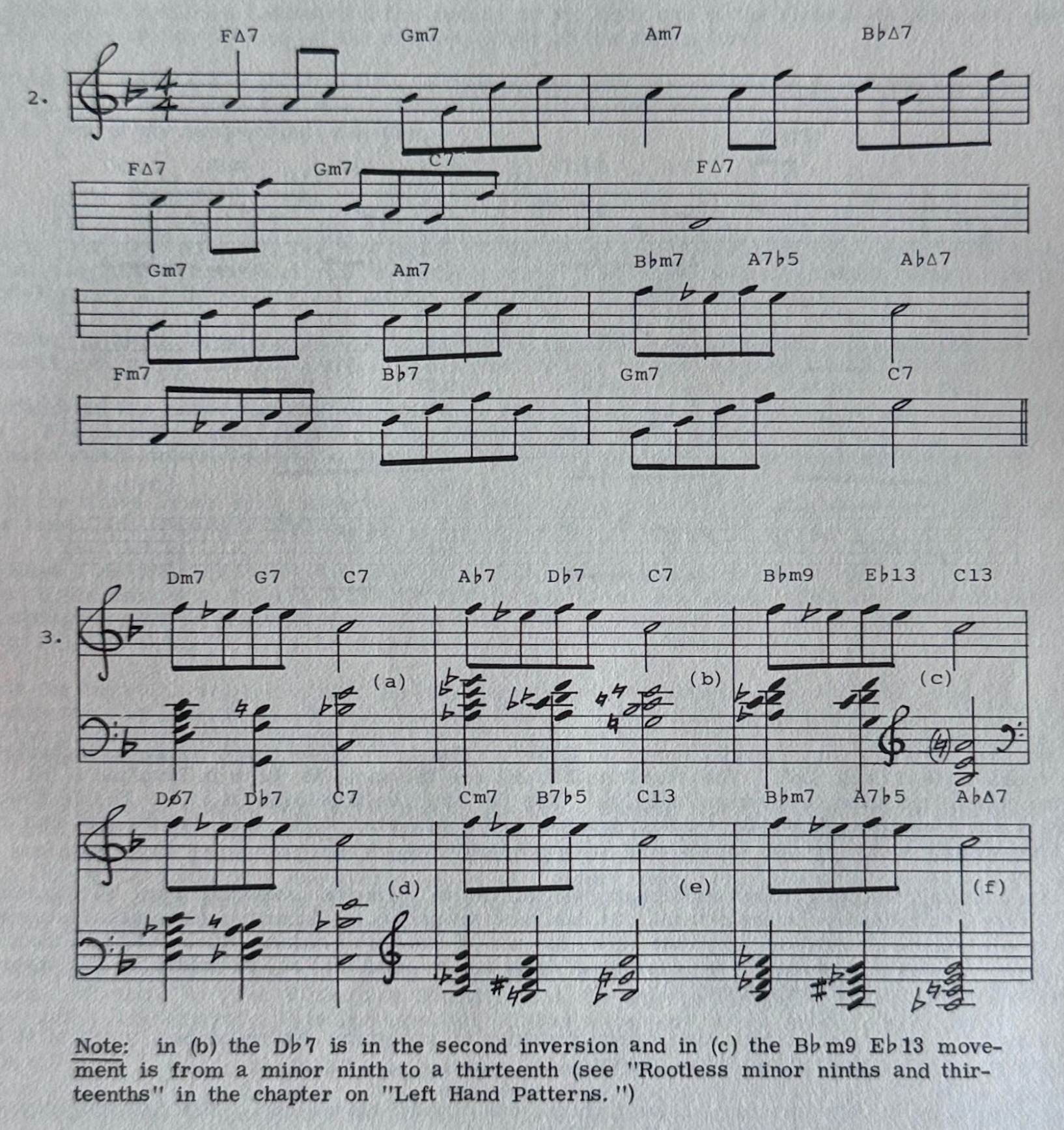
Instead of starting with a III chord in bar one we can have two beats on the I (the tonic) followed by two beats on the II chord. Bar two can be covered by an extension of this with two beats each on III and IV. In bar three we can have two beats on I with a beat each on II and V to lead to the I chord in bar four. In the first two bars the diatonic sevenths change in order of their position in the scale of F major (F–G–A–B♭) Example 2.
We have already noted that the melody notes in bar five clearly form a Gm and Am. There is no advantage in changing these chords other than making them sevenths. However, bar six gives scope for at least half-a-dozen harmonic variations. Examples 3(a) to 3(f) show the kind of choice there is. The II–V movement is real or implied in all cases; the second chords of (d), (e), and (f) are tritone substitution. These sequences represent very brief key changes to: (a) C (b) G♭ (c) A♭ (d) C (e) B♭ (f) A♭. Only (a), (d), and (f) lean towards their tonics. (a) and (d) arrive at the tonic but it is changed to a seventh to lead into the next bar. In Example 2 (the eight bar theme) I have chosen Example 3(f) for bar six.
In Examples 3(a) to (f) it is easy to see in (a), (b), (d), and (f) the relationship between the three chords in each example but it is not so apparent in (c) and (e).
In (a) there is a II–V–I7 sequence. In (b) A♭7 and D♭7 are tritone substitutions and so is the D♭7 in (d) and the A7♭5 in (f). In (c) the E♭13 has three notes (G–D♭–F) which are a part of Gm7♭5 which resolves to C7. The C could be regarded as an eleventh. I am sure you will realize by now that jazz harmony uses a great variety of circle movements. Finally the B7♭5 in (e) can be rearranged to make a G+7(9) without its root (F–B–D♯). The A is the ninth. Augmented and dominant sevenths resolve to tonic chords.
We have already decided that bar seven's chords form an Fm and a B♭ chord to be played in sevenths, no other alteration being needed. We know that the first four notes of the last bar form the II chord (Gm7). We should leave this as it is and logically link the last melody note with the V chord (C7) which is what we worked out.
An important factor in the process of harmonizing a melody, especially if it is your own composition, is that the melody you create needs to have a strong harmonic interior otherwise it becomes more difficult to find suitably nice-sounding chords to help it along its course.
It is interesting to consider the difference between harmonizing an original melody and finding the correct harmony for a well-known tune you wish to play by ear. We have looked at the method for finding chords for a simple melody. We can use the same processes to find chords to fit a piece we have heard but never played before. I think that an even better ear for harmony and melody is required as we have to find, if possible, the chords the composer had in mind when he wrote his melody. Many of the most enduring compositions have unusual harmonic twists and changes which if discarded alter their character and make them less interesting. This is where an accurate ear can make all the difference in tackling this problem. It is better and easier to buy the sheet music. But as so many classical jazz evergreens are no longer in print playing them by ear is sometimes the only way to learn them.
Part Three - how to harmonise
There is one other type of harmonic progression which can be used to harmonize a melody. We have used diatonic movements and circle of fifths but we only experimented with chromatic sequences in one bar in part 2 (bar six). There are two types. One consists of two or four chords moving downwards from minor sevenths to dominant sevenths, e.g., Am7–A♭7–Gm7–G♭7. The other kind is usually an upward movement in diminished sevenths followed by minor sevenths, e.g., F♯o7–Gm7–G♯o7–Am7. If you look at the eight bar melody (Example 4) you will see I have used the latter example in bar one and the former example in bar two. There is a nice melodic feeling to the diminished seventh to minor seventh sequence.
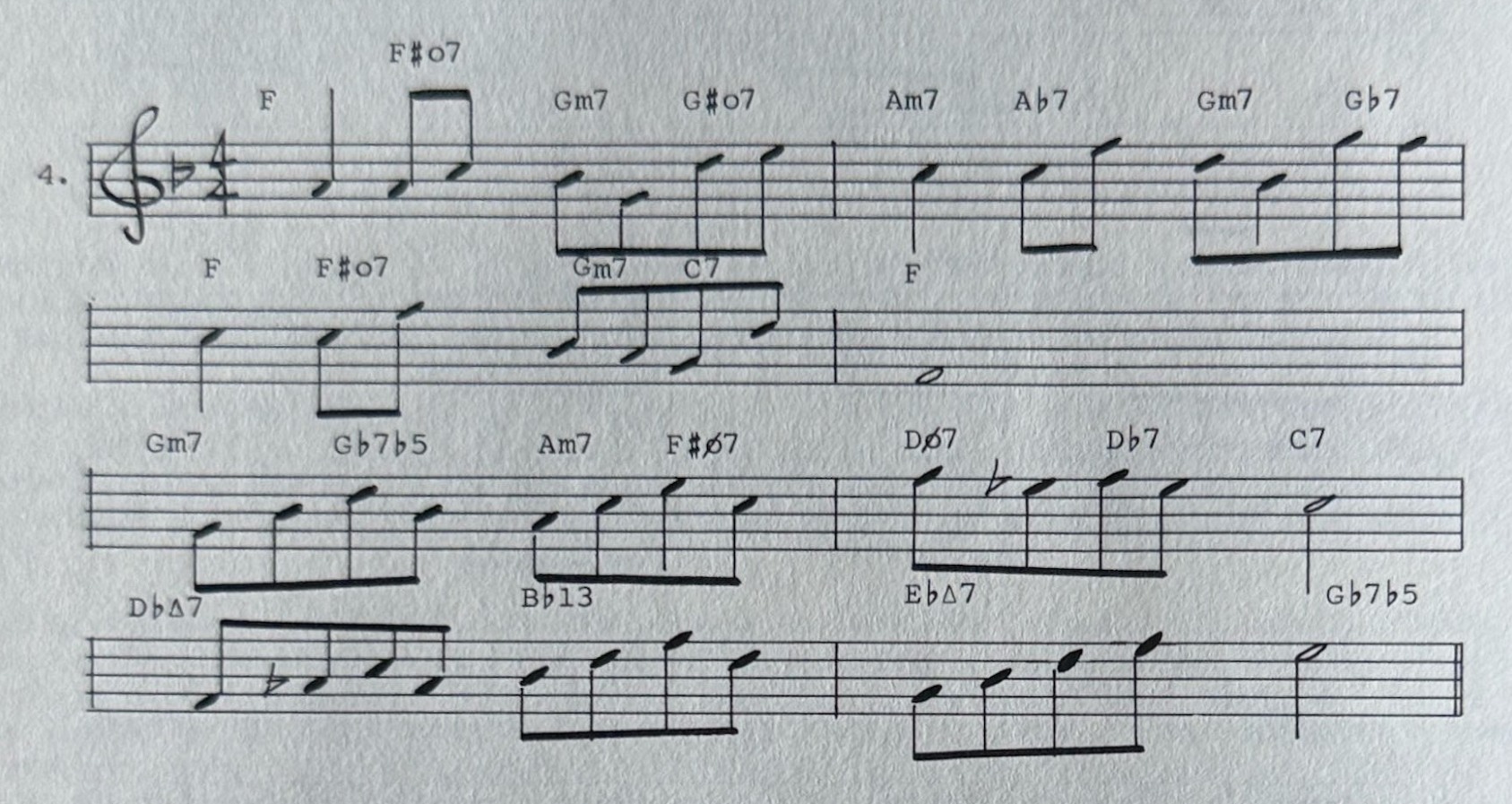
In bar five the Gm7 chromatically moves to G♭7♭5. The F♯ø7 is the third inversion of Am6 which is a suitable chord to lead on to Dø7. The chords in bar six are the same as those in Example 3 (d). The D♭△7 in bar seven has notes in common with Fm. The D♭ could be considered a ♭13. The B♭13 sounds better if it is played as a rootless three-note thirteenth in the left hand. The E♭△7 in the last bar clearly includes three melody notes and the G♭7♭5 is a tritone substitution for C7.
To summarize, the basic chord movements we can use to harmonize melodies are: 1) Diatonic; 2) Circle Of Fifths; 3) Chromatic (minor sevenths to dominant sevenths); 4) Chromatic (diminished sevenths to minor sevenths). These groups can be enhanced by the use of substitute chords which relate to their originals by having two basic notes in common; the remaining notes can be identified as chromatic in that they are usually flattened fifths or flattened ninths.
As a routine, when you examine the melody you wish to harmonize determine how much of it is diatonic and note areas where chromatic notes appear.
When dealing with diatonic notes, diatonic chords can support the melody. The following diatonic patterns could be used: 1) I–II–III–IV; 2) II–III–IV–V; 3) IV–III–II–I.
In practice diatonic patterns appear side by side with circle and chromatic movements.
Earlier in this study I pointed out that the II–V chord sequence was used extensively in all compositions and that it appeared in key changes within the number being played.
Here are two main circle patterns: 1) II–V–I; 2) III–VI–II–V–I. The chromatic movements often used are: 1) I–♯Io7–II–♯IIo7–III; 2) III–♭IIIo7–II–♭II△7–I; 3) II–♭II7–I; 4) III–♭III7–II–♭II7.
You can see in Example 4 the suggested harmony includes many of these chord patterns.
The biggest problem is sorting out the chromatic notes in the melody and deciding which chords fit them best. In bar six of our melody we found there was a lot of chord choice available to fit in with the E♭ melody note. The fact is that countless chords can be built which include E♭. The one you eventually choose, in the majority of cases, must relate to the previous and following chords.
Bar seven was easy to work out as the notes were associated with the chords we used.
So far we have not considered the problems involved should a melody in a minor key present itself. A minor character would be indicated if the melody in the first bar of the chorus spelled out a minor chord with its first note on the keynote of the relative minor of the key in force.
If the key signature were F and the melody in the first bar started on D natural the scale of D minor may be indicated. In a case like this I think the easiest course would be to write out the minor scale sevenths at the top of the manuscript, like this:

After you have done this see how much of the melody can be matched with minor scale sevenths. Don't forget that very few compositions will be entirely minor. Segments will slip in and out of major keys. Im6–VIø7–IIø7–V and IVm7–IIø7–V–Im6 are sequences which can be used with a minor theme.
Tunes in major keys may have a small number of bars in a minor key which may not fit comfortably into a backing of major diatonic chords. When this happens try out the minor scale sevenths.
While we are examining minor chords note that a minor sixth is the first inversion of a half-diminished seventh. For example, Im6 and VIø7. We often find Cm6–D7 which is the same as Aø7–D7. The half-diminished seventh sounds better than the minor sixth when resolving to the dominant seventh.
In the above minor scale sevenths Im6 is sometimes used instead of Im△7. The sixth is compatible with the minor scale sevenths when added to a minor triad in the root position.
When a melody with chromatic notes is considered the chords relating to the notes can be more easily identified if the kind of accidentals expected in the scale in use are noted. This can be accomplished if we use as examples diatonic scales with most of their notes on the white keys of the piano. Obviously, an accidental in, say, the key of D♭ has to be worked out more carefully, whereas in C, G, or F it is visually evident.
In the key of C major the most likely accidentals will be sharps: C♯, D♯, F♯, and G♯. If there were temporary key changes where flats were involved as F is a fifth down from C, a B♭ might turn up. If it does the obvious chords to try out would be C7, Gm7, or B♭. The appearance of additional flats would indicate further temporary key changes.
If a chromatic note is part of the melody and not a passing note it can be any component note of a chord: root, third, fifth, or seventh. However, certain chords are more likely than others. For instance, in C a sharpened note would likely be a major third of a triad or seventh or part of a diminished seventh. In which case a C♯ could be a major third of A7 or a minor third in a diminished seventh (e.g., Go7). D♯, G♯, and F♯ could also be part of major or minor intervals. F♯, for instance, could be the fifth in B7. There are many alternatives to be tried.
When Em7 is the II chord in the key of D major it can support a melody note of F♯. D major has two sharps, F♯ and C♯. The V chord in D major is A7 so the appearance of F♯ or C♯ in the key of C could indicate a key change to D major especially if they were part of the same melodic phrase.
If G♯ were a component of E7, the previous chord could possibly be a Bm7 making a II–V progression suggesting a key change to A major. If the chromatic notes turned out to be major thirds of temporary dominants then they might be played against the tonic chords of the temporary dominants. For example, if F♯ is the major third of D7 then the tonic chord would be G (a major or minor triad). The F♯ could happily be played against this tonic chord. When D♯ is part of a B7 chord it too can be played with the tonic chord--E in this case. Clearly this kind of relationship applies to all chromatic notes in a diatonic scale.
As minor key changes include chromatic notes try to decide if accidentals belong to minor keys if temporary major key changes do not account for their presence.
It is well to remember that the B section in songs with an AABA construction invariably moves into a new key changing back to the original key in the last eight bars.
Harmonizing melodies in the comfortable keys of C, G, and F will make it easier to cope with the more difficult ones. In an emergency a melody in a troublesome key could always be transposed to C or F to be harmonized and when completed returned to the original key.
These guidelines should help in the task of harmonizing a simple melody. Unfortunately there are no hard-and-fast rules as clever composers tend to break them all at times and do the unexpected, which is why they enjoy success.