Jazz Patterns
Once you start experimenting with improvisation you need to collect in your musical memory phrases, embellishments, and melodic lines which can be used again or recycled to dress up other numbers. We can call all these ideas jazz patterns.
At first most of your patterns will be borrowed from performances heard on records or live at concerts or clubs. Listen to the way soloists move from one theme to another and how the last few bars of a chorus are joined up with the next run-through. Try them out yourself and decide which patterns can be used with different numbers. After a while you will find you can make some patterns of your own based on what you hear. Using patterns you hear and create yourself will make your own improvisations more interesting and eventually you will develop a personal style and avoid becoming just a facsimile of what somebody else is playing.
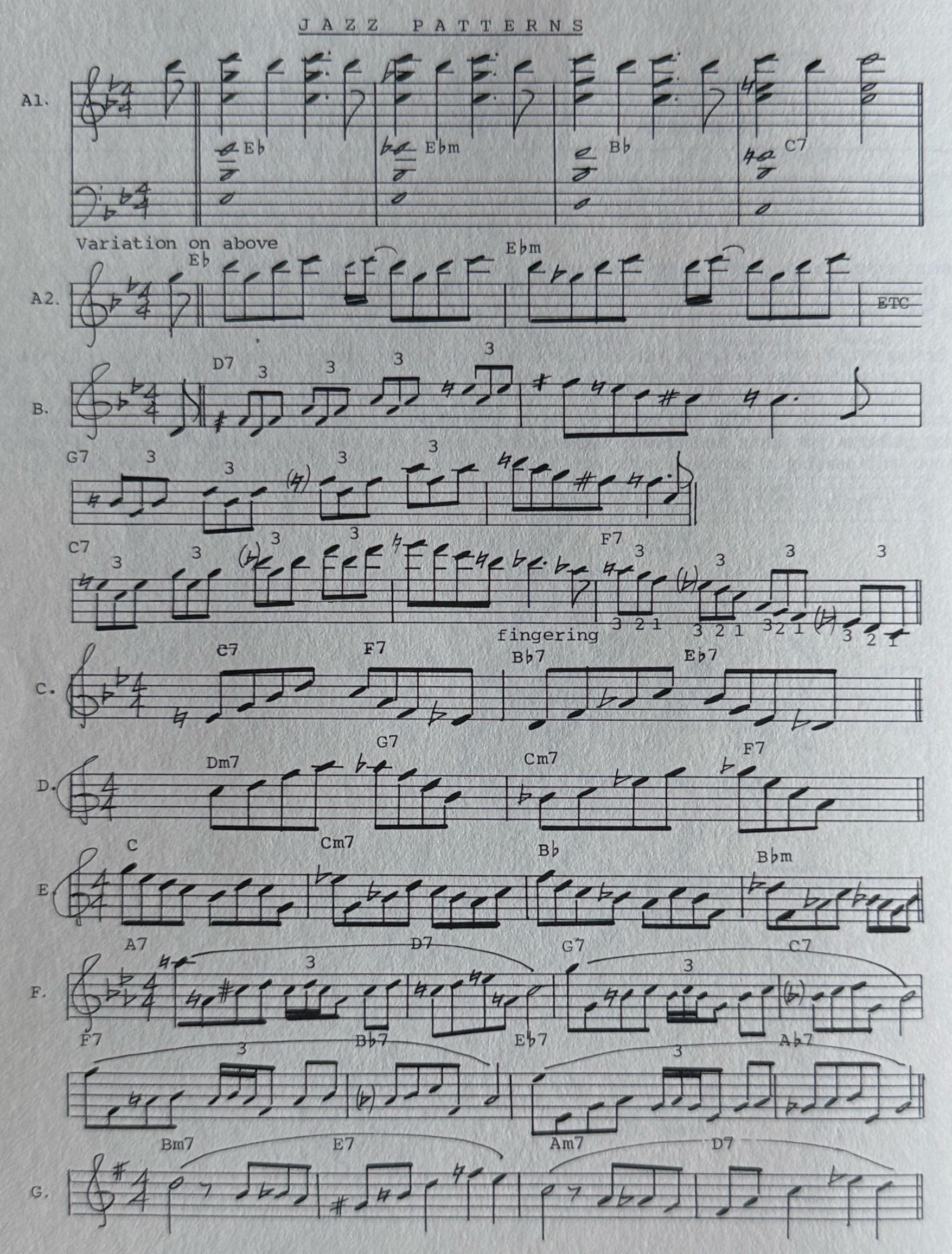
I have written out a few examples of patterns which can be used in different numbers. In example A1 I have illustrated a chord sequence which often turns up in mainstream numbers -E♭-E♭m-B♭-C7-. The right hand is based on the kind of pattern you might find in a Waller or Hines solo. A2 is the same thing in single notes sufficiently varied to make it an alternative pattern for the same chord sequence. It is a pattern which can be adjusted to fit in with numbers like "I Can't Believe That You're In Love With Me," the middle eight of "My Monday Date" and bars 13 to 16 of "Keeping Out Of Mischief Now" (B♭).
The chords in Example B (D7-G7-C7-F7) are the changes for quite a number of middle eights like, "I Can't Believe...," "Perdido," "I Got Rhythm," "Queen Bess," "Squatty Roo" and "Please Don't Talk About Me When I'm Gone." Any pattern which can fit into this sequence will be useful. I have given you one but better still why not work out one for yourself. There are two bars for each chord which gives quite a lot of space. Try it with one of the above numbers to see if it works. When you have found something which fills up these eight bars catalog it away in your mind and bring it out at the first opportunity.
The patterns in Examples E & F are in the bop tradition. The pattern in G is a good instance of a well-constructed four-bar link between choruses which flows and is melodic. It has been used in "Ornithology" and "How High The Moon."
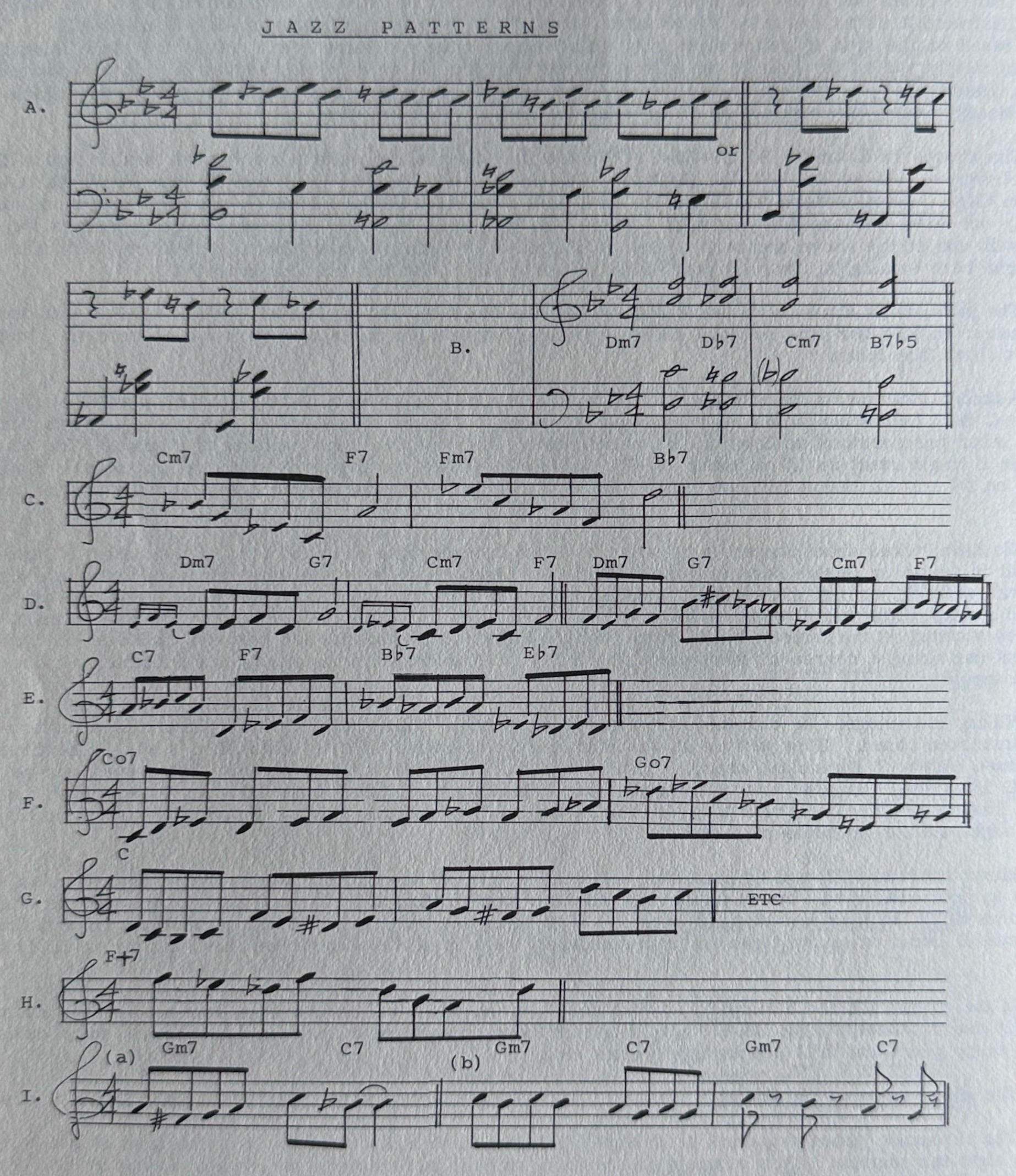
Although Example D is only two bars long the chords can be extended by moving down whole steps. In Example C the progression could be started on D7 going to G7 and then C7. In fact many patterns can be used on other progressions as long as the relationship between each chord remains the same. The chord sequence in B might start on C7 to make C7-F7-B♭7-E♭7. Whatever pattern you chose for the set of chords starting on D7 will fit the pattern starting with C7 if you transpose the melody line when the chords are changed.
Patterns which fill in single or double bars
We have talked about longer jazz patterns which covered four or eight bars of a number. Patterns which fill in single or double bars are most useful as they are the type of bars which connect one eight-bar theme with another, or two sixteen-bar themes as well as the final bars of a chorus. These are often bars with tied melody notes which allow a lot of room to be filled up with a suitable jazz pattern. Even if you have been sticking to the melody fairly closely the inclusion of a jazz pattern between choruses or a circle movement can bring a degree of excitement which lifts the whole performance up and encourages more daring ideas to appear.
Filling in a single bar can be made interesting. Look at Example F which illustrates a pattern suitable for a diminished chord. This pattern is based on the whole step-half step diminished scale. The first bar can be used with a C diminished chord. The second bar shows a variation on this scale which can be used with a G diminished chord or one of its inversions. In Example H the pattern fits an F augmented seventh chord. The notes are taken from a whole tone scale in F. Example G is a typical two bar fill-in that Teddy Wilson might use for a couple of bars.
Minor sevenths followed by dominant sevenths turn up all over the place in everything you play so a few patterns up your sleeve will be useful here. The two bars in Example C could fit into any two bars at the end of a chorus in E♭ to lead into another chorus. Try them out with an E♭ blues. The Dm7/G7 and Cm7/F7 in Example D occur so many times in jazz standards there must be somewhere these patterns will find a home.
In the (b) section for Example I is a famous pattern which all mainstream trumpet leaders know and invariably use in "Honeysuckle Rose." It is one of those marvellously spontaneous patterns which dates back at least thirty years but still seems appropriate today.
The chord sequence in Example E should not be difficult to find in your collection of jazz numbers.
The chromatic chord sequence in Example B leads on to a B♭ chord. It is the kind of two-bar bridge between eight-bar themes. This example in common with all patterns can be transposed to any key.
The pattern in Example A originated from Erroll Garner. Try and fit it into bars 7 and 8 of "There'll Never Be Another You."
Quoting
The process of introducing an easily identifiable fragment of a well-known tune into the framework of the number being played is usually referred to as "quoting." This musical device, so popular with jazz musicians, comes under the heading of improvisation. It can be creative, humorous, witty, or just downright irritating if it is indulged in too much. It is a pattern limited to just one particular tune.
To fit a quotation from one number into another requires skill and imagination. It does not matter what you quote. It can be a classical theme, another jazz standard, or even a nursery rhyme. Anything will do provided it fits into its new setting exactly without gaining or losing a beat. To do this successfully the quote ideally should have a few notes which are common to both numbers. If the notes common to both numbers are at the beginning of the quotation it sounds more convincing and acceptable.
There are countless examples of quoting. Listen for them when you play records in your collection. Two instances which come to mind are Art Tatum's introduction of "Blue And Sentimental" in his solos of "Sweet Lorraine." The other one is Dizzy Gillespie's quoting from "Laura" in "Perdido" in the Massey Hall Concert recording. If you have this LP see if you can identify the other quotes by both Dizzy and Charlie Parker in the same tune.