Jazz Scales
The study of scales can cover so many different varieties it would require more space and time than is available in a book of this size.
I think the easiest compromise is to write out a scale for all the basic chords and introduce the Pentatonic five-note scale which can be played with dominant sevenths and minor sevenths successfully.
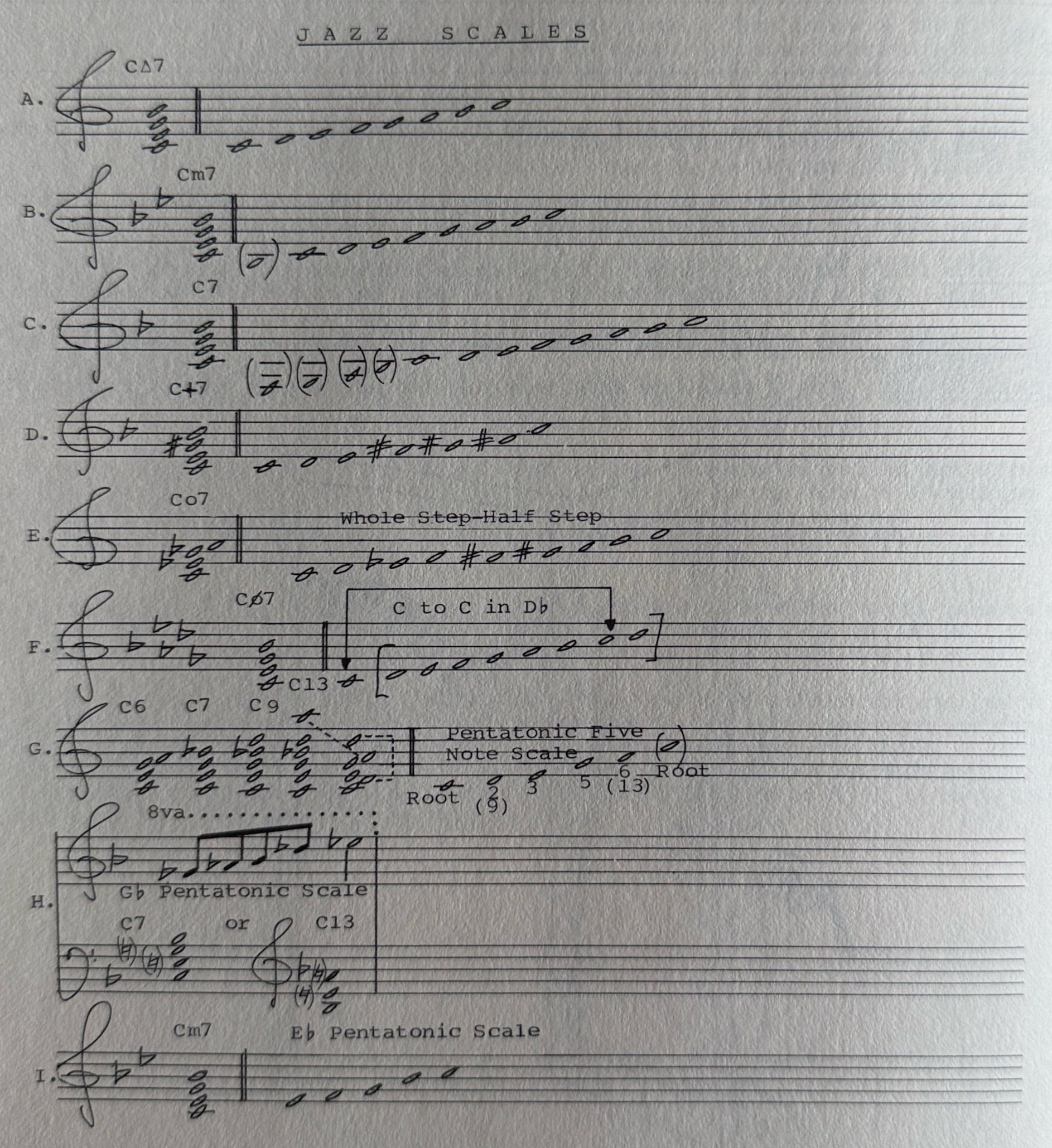
Major Chords take a major scale based on the root note of the chord. Example (A).
Minor Chords. Play a major scale in the key a tone below the root note of the minor chord. Example (B).
Dominant Seventh. Play a major scale a perfect fifth (seven semitones) below the root note of the dominant seventh. Example (C).
Augmented Seventh. Play a whole-tone scale from the root note of your chord. Example (D).
Diminished Seventh. Play a diminished scale from the root note (Whole step-half step). Example (E).
Half-Diminished. Play a major scale in the key half a tone above the root note of your chord. Example (F).
In minor, dominant seventh, and half-diminished chords the starting note of the scale given is on the root note of the chord being used not the keynote of the scale. For example, the B♭ major scale to be played with the Cm or Cm7 chord has its first note on C not on B♭. Example (B). The remaining chords and scales are compatible having no need for the scale position to be adjusted.
Pentatonic Five-Note Scales
As so many dominant sevenths are used in jazz harmony you will need to have many different right hand patterns to make your improvisations more effective when these chords appear on lead sheets. You can see in Example (G) that the five notes of this scale are part of a CΔ6 chord with an added major second (ninth). Consequently the inversions of this chord scale can be employed just as well.
Like the composite chords pentatonic scales starting on different notes to the root note of C7 can be performed against the chord so that in theory you have contrasting chord voicing in your right hand compared with your left which combine to make an interesting sound. For instance, if you play a C7 in the left hand but finger a pentatonic scale commencing on the ♭V position the resulting scale includes chromatic notes which blend with the dominant seventh: i.e., ♯9, ♭9, and ♯11. If you play a rootless three-note thirteenth in the left hand the combination of chord and scale sounds even better. The right hand pentatonic scale starting on G♭ (♭V) spells out a G♭Δ chord. So you are, in effect, playing a G♭Δ against a C13; hence the connection between pentatonic scales and composite chords. Example (H).
When playing a minor seventh in the left hand a pentatonic scale starting on the minor third complements it. Example (I).
Pentatonic scales and their inversions played on all notes yield a formidable variety of sounds at your disposal.