Left-Hand Patterns
What to do with the left hand can be a worry. It is, of course, very much involved with style. A versatile left hand is a great asset. In contemporary jazz the left hand is badly neglected. Older pianists who have evolved through traditional jazz and swing to present day styles are used to relying on their left hands not only to maintain a good rhythm but to combine with the right hand in forming attractive sounds which enhance their solos.
I am going to start the ball rolling with a kind of left-hand clinic. In Example A I have taken the first four bars of a twelve-bar blues. The left-hand part is constructed for pianists with small hands. In Example B I have written out some three-note tenths for larger hands. In slow blues and ballads a full left hand gives body to the solo and a richer sound to the harmonies. The middle note in the three-note tenths is usually the fifth or the flattened seventh from the root note of the chord. Tenths can be major or minor intervals. They can move like a chord sequence or progress chromatically. The left-hand part in example B is typical of the kind of bass Pete Johnson liked to use in a slow blues. Many other players have adapted this left-hand part to meet varying musical situations. Pianists with small hands need not despair because rootless three-note thirteenths are designed to meet their problems. I will tell you about them at the end of this chapter.
Left-hand patterns in the twenties and thirties were rather stiff and less interesting than they are today. In those early days the left-hand part often consisted of a steady four beats to the bar of single note/chord/single note/chord; or an octave instead of the single note. The monotony was relieved by the occasional bar of octaves moving towards the chord in the following bar. Very few pianists attempted to experiment and although players like Earl Hines and Fats Waller used tenths and more sophisticated voicings it was not until the emergence of bop that players began to break away from the old traditions.
Here are two examples of the importance of the three-note tenth in left-hand work (Example C). Both Fats Waller and Joe Sullivan have used the downward moving three-note tenth. These tenths have been broken down into single notes in the third and fourth bars to introduce a different rhythm. The single notes have been taken from the three-note tenths in brackets.
Teddy Wilson and Mel Powell use the broken three-note tenths as an accompaniment to a fast right hand solo. Its effect is of a compact stride style without the hand having to jump one or two octaves all the time. It is a kind of mini-stride. The exercise in Example D shows how it works.
Play the three-note tenth as a chord first. These are in brackets. Work the right hand patterns with the chords. After you have got the feel of the tenths then break them into two beats as written. When your left hand is relaxed try playing the broken tenths (mini-stride) to support the right-hand melody. Practice until you can work up to a bright tempo.

Rootless Three-note Thirteenths
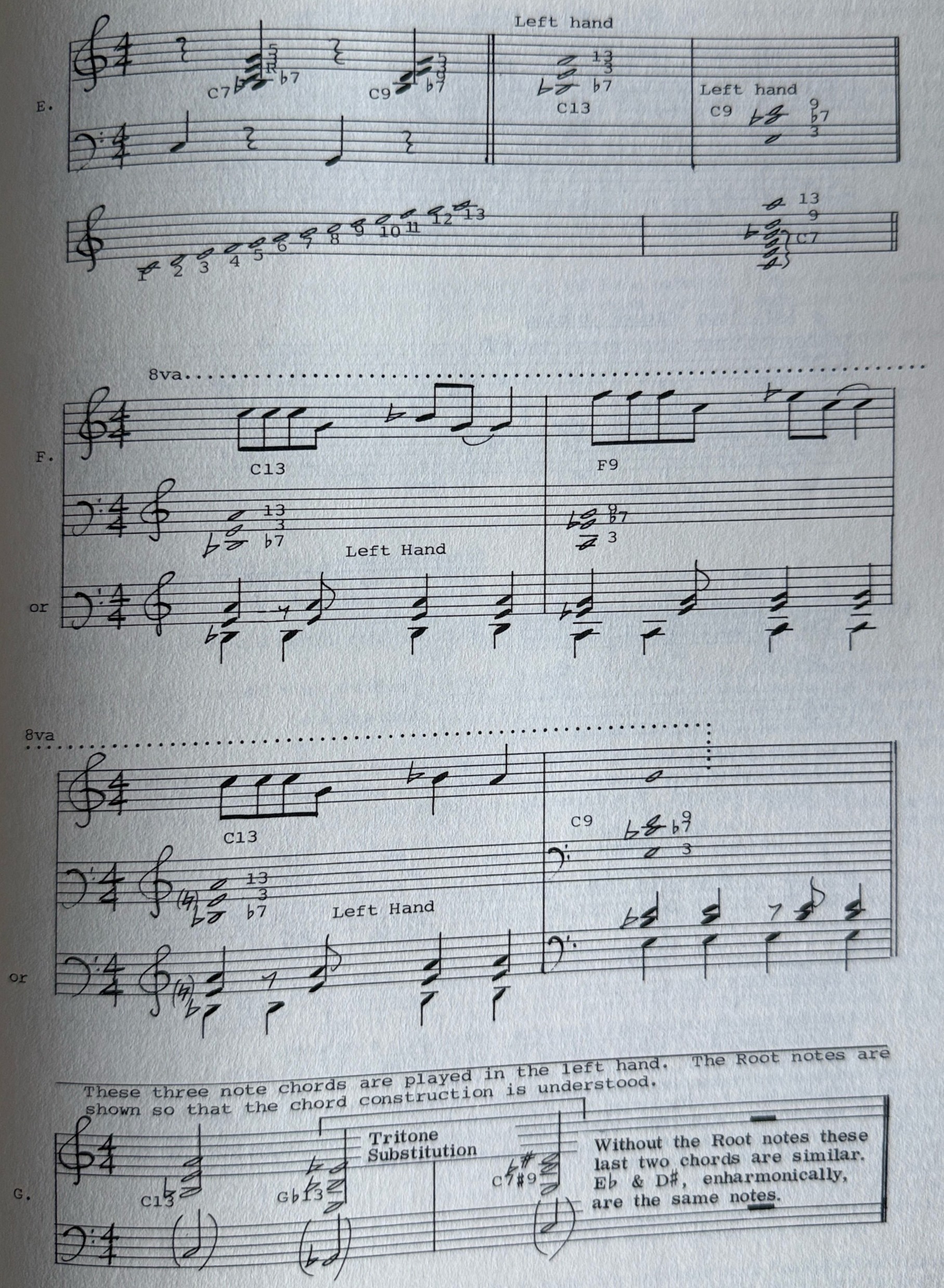
Rootless three-note chords for the left hand are used extensively in all styles of contemporary piano. These chords are a kind of abbreviation of the old stride routine of root/chord/fifth/chord to just chord. The rule is simple. Take any dominant seventh (root-third-fifth-flattened seventh) use the third inversion leaving out the root note. If we tried this with a C7 we would arrive at B♭, E and G. But if we make the chord a C13 instead we can get a better sound. You will remember that intervals of a ninth, eleventh, and thirteenth can be added to a dominant seventh. If we play the major scale on the root note of any dominant seventh being used we can number the scale from the tonic, 123456789, etc., so that when we talk about the 9th, 13th, or some other interval we can see its relationship to the dominant seventh.
Returning to the C13, as A is the thirteenth note of the scale of C major we add A above the flattened seventh. If it were placed below it would become a sixth instead. Leave out G (the fifth) so that we keep to just three notes. The rootless three-note chord finally becomes B♭–E–A. These chords can be played in the left-hand with the bottom note on the third instead of the flattened seventh. In the case of C7 this would be E. In this inversion a ninth is more appropriate than a thirteenth if we are to space out the three notes comfortably. The first inversion of C7 has a bottom note of E producing a chord of E–G–B♭–C. Add D (the ninth) and dispense with C (the root) and G (fifth) to arrive at a chord of E–B♭–D (See Example E).
In Example F I have written out the first four bars of another blues with two left-hand patterns to practice. The first pattern gives a sustained chord in each bar. The alternative left hand shows an Erroll Garner influence. It should be lightly percussive in character, beating out the time. The second beat in the first three bars and the third beat in the fourth chord to avoid the monotony of too metronomic a pulse. The second bar uses an F9 with the bottom note on the third interval (the first inversion), a flattened seventh and a ninth, A–E♭–G. As the basic chord on which the ninth is added is a dominant seventh (F7) our major scale would be FGA B♭ CDEFGA, etc. If you number these notes in order you will be able to see the intervals we have employed in our voicing.
Rootless three-note thirteenths have an interesting function connected with circle movements. If you make a half-step movement with rootless three-note chords in the bass (e.g., B♭13 to A13 or C13 to B13) you are, at the same time, using tritone substitutions to move through a circle of fifths. The A13 is a tritone substitution for E♭13 and the B13 for F13. So in effect the movement is B♭13 to E♭13 and C13 to F13. In Example G you can see that chords and their tritone substitutions are related to a common root note. C in the bass sounds right for either chord shown; in the same way G♭ can be used with both chords. The rootless three-note thirteenth and the tritone substitution have two notes in common. The remaining note ♯9 (E♭) is added to the original chord.
Have another look at the middle eight of “Lazy Latin Mood” in the chapter on Diatonic Harmony. You will see that the chromatic movement of the rootless three-note thirteenths is a circle of fifth progression using tritone substitution: B♭13–E♭13(A13)–A♭13–D♭13(G13) and C13–F13(B13)–B♭13–E♭13(A13)–A♭13–D♭13(G13)–G♭9(C9).
Rootless minor ninths and thirteenths in the Open and Closed Voicings
There are other kinds of rootless chord movements which can be used in the left-hand.
It is acknowledged that dominant sevenths sound better if they are preceded by minor sevenths. II–V movements can be constructed which are an extension of the rootless three-note thirteenth.
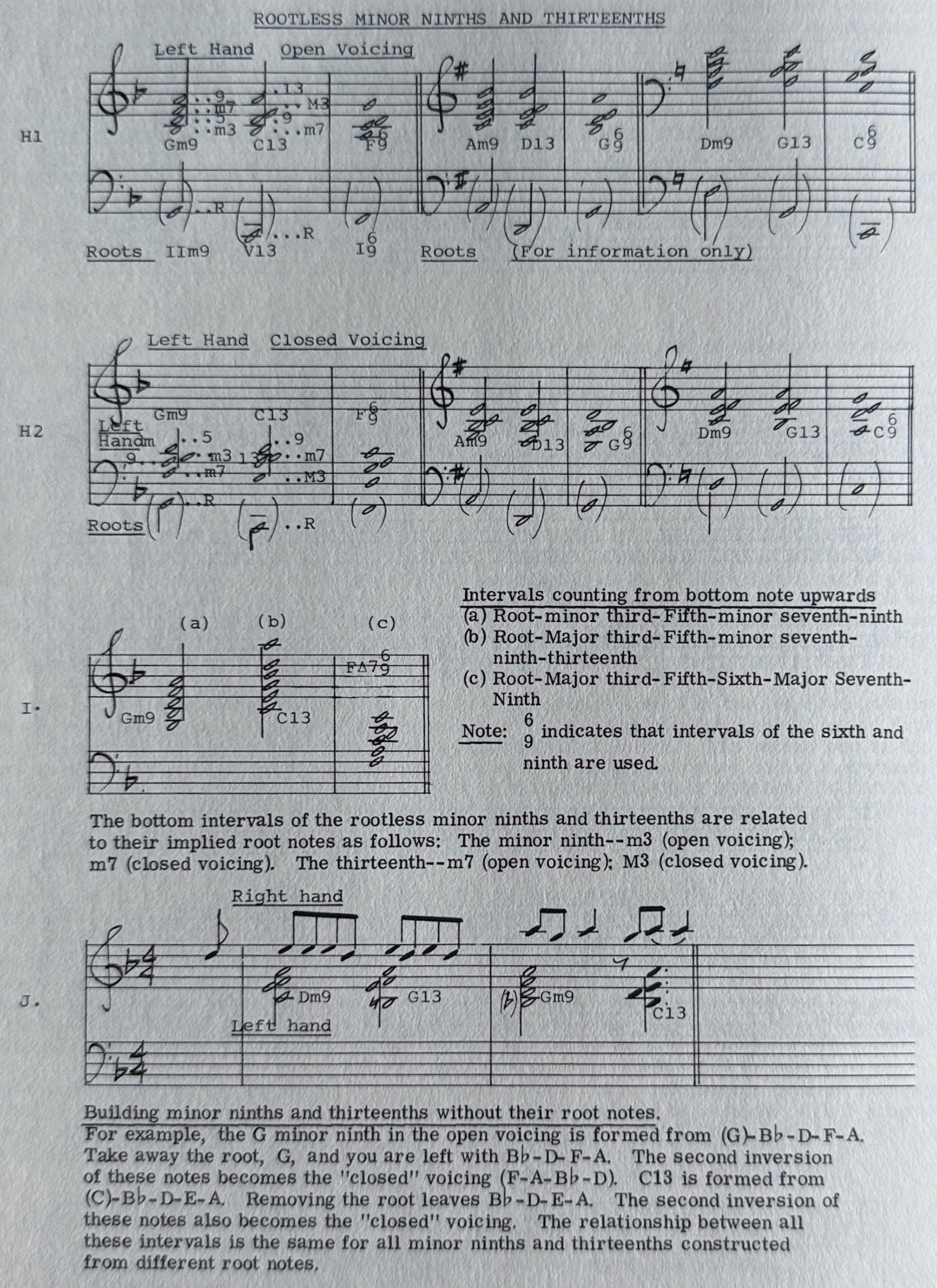
In Examples H(1) and H(2) you can see rootless minor ninths followed by rootless thirteenths resolving to their tonics (a ninth with added sixth).
H(1) is the open and H(2) the closed voicing of these chords. Both types are used extensively by popular modern pianists.
The closed voicings sound better than the open ones. It depends on your right-hand melody line. The closed type loses clarity if it is played too far below middle C. For example the Gm9/C13 is just about clear enough but it sounds better an octave higher. The H(1) group being more open can be played within the octave from middle C downwards. If it is possible use this kind of left-hand pattern above middle C playing the melody an octave higher than written to allow for it. Rootless three-note thirteenths, rootless minor ninths and thirteenths are not strictly speaking proper chords as their root notes have been dispensed with.
Work out these chord voicings on as many IIm9–V13 movements as you can. In Example I the voicing of Gm9/C13 is written out in its basic form. Example J illustrates the effect of combining these voicings with a melody line.
Rootless minor ninths and thirteenths are given here as left-hand patterns. They can be moved up to the right hand to be blended with the melody and improvisation to create attractive harmonies.
To calculate the intervals to be used in making rootless minor ninths and thirteenths work from the root upwards as follows:
minor ninth (Open voicing) – (R)–m3–5–m7–9
(Closed voicing) – (R)–m7–9–m3–5
Thirteenth (Open voicing) – (R)–m7–9–M3–13
(Closed voicing) – (R)–M3–13–m7–9
Take away the root and you have the final rootless voicings.