Modes
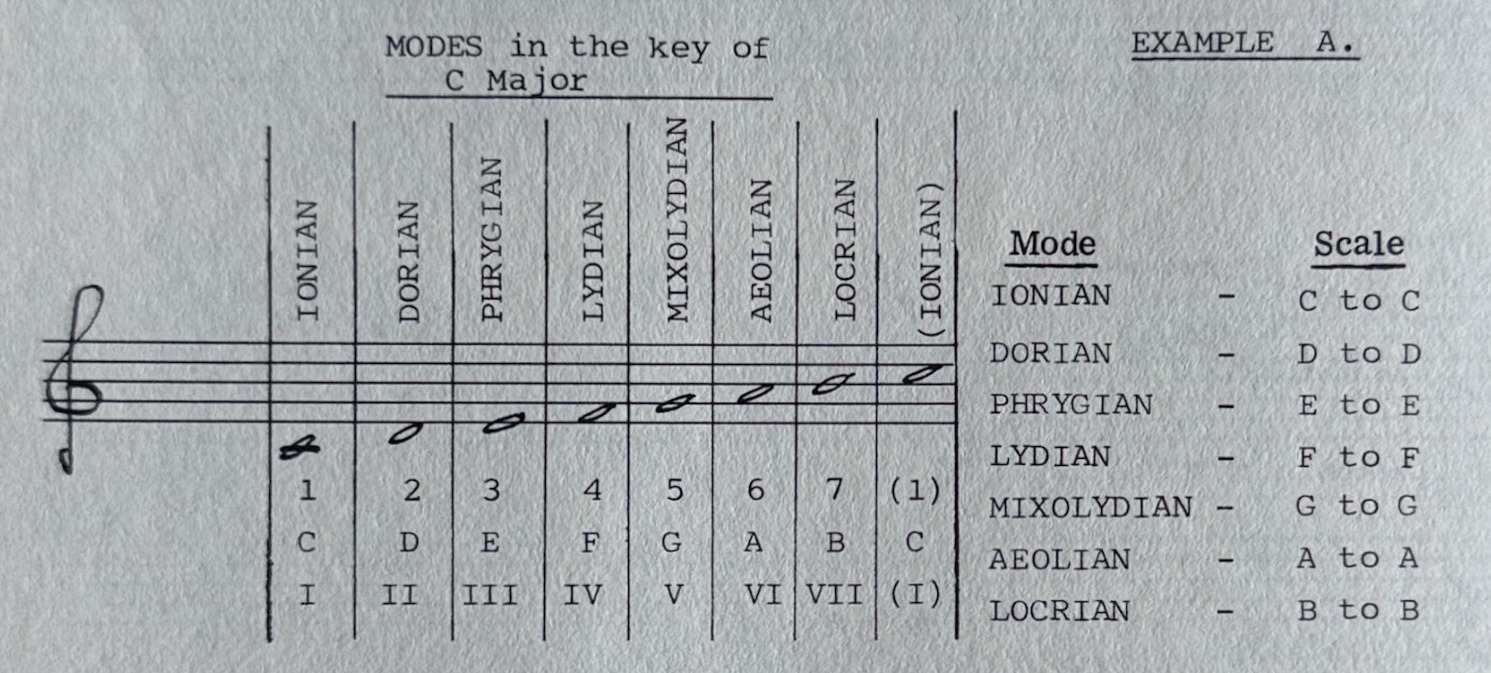
Modes are scales based on the degrees of the diatonic major scale. In C major (see Example A) the Ionian mode is from C to C. So all major scales in their tonic position are in the Ionian mode. The Dorian mode is from D to D and the Phrygian mode is from E to E and so on. Because modes are diatonic, only the white notes are played in the modes formed from the notes of C major scale.
The earliest modes were of medieval Greek origin. According to Ptolemy the Greek names were applied to the wrong modes. The first four modes of the medieval church started on D and had the same names as we give these notes today. The remaining four were differently named. The Ionian mode (major scale) and the Aeolian mode (relative minor) were added in the sixth century. So the seven modes of the Twentieth century have had a long history. It must be said that we do not know what Greek melodies sounded like but we do know that Aristotle thought that the different modes evoked different emotions in the listener.
It is interesting to realize that the Greeks and Eastern Christianity used eight modes. Later there were twelve-mode systems which were operating as late as the Nineteenth century. In the second half of that century English folk songs were often modal using our present seven modes. For instance, "What Shall We Do With A Drunken Sailor?" is written in the Dorian mode. The popular Christmas carol, "The First Nowell" is in the Phrygian mode.
Of the seven modes the Ionian (the major scale) is the most popular. The relative minor scale which is the Aeolian comes next. The Dorian mode has some potential in composition.
There are two ways modes can be used in jazz. The more ambitious of the two is to compose with the clear intention of basing themes in chosen modes. These compositions allow the performer to improvise on scales rather than chords which gives the soloist infinitely more scope for variation than being restricted to playing passages constructed from just chords.
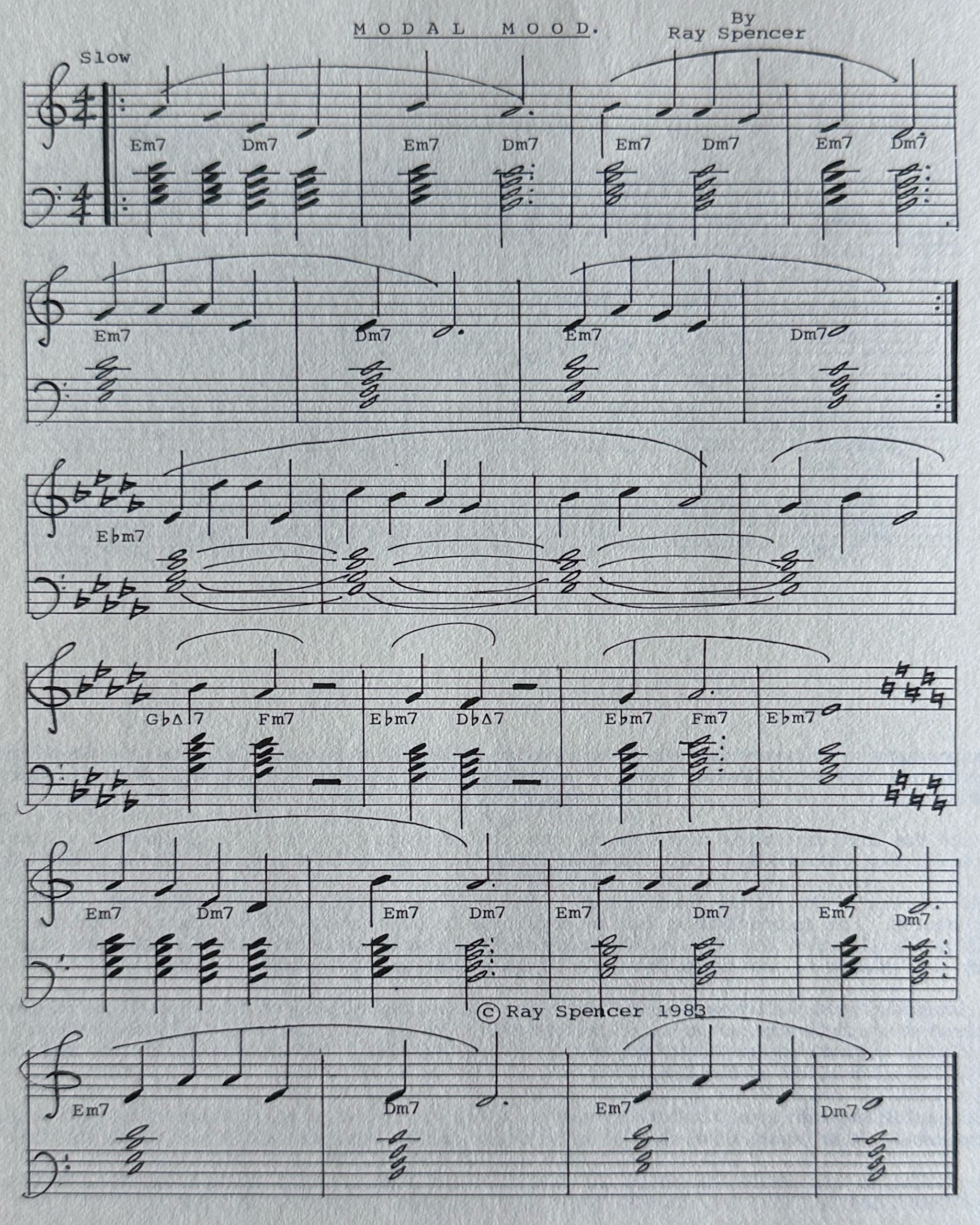
A modal piece is likely to be in one or two different modes with maybe only two chords supporting the whole number. The chords allow the pianist to give an accompaniment which he can make interesting with some ingenuity on his part. If the composition is constructed in the Dorian mode with say, sixteen bars in D Dorian, a middle eight in E♭ Dorian returning to D Dorian for a final eight bars the pianist has only two chords to play over thirty-two bars. Obviously he must do something to prevent his backing sounding monotonous. This can be achieved by using modal diatonic sevenths. D Dorian is in the key of C major so its modal sevenths starting on D minor seventh using just the white notes will be the same as the diatonic sevenths built on C Major but starting on D instead of C.
E♭ Dorian is located on the second degree of the scale of D♭ major so its diatonic sevenths starting on E♭ minor seventh use the notes of the D♭ major scale. In our model composition (see "Modal Mood") the basic two chords are Dm7 and E♭m7. This is an AABA form. I have added Em7 in the A section. It is a modal seventh from the D Dorian. G♭△7 and Fm7 are also modal sevenths from E♭ Dorian. This would give a better backing to a soloist than restricting the accompaniment to two chords. The soloist will be improvising on the notes of the two scales (modes) and not on any chord sequence. See Example B for an illustration of how sevenths are formed on the different modes which are built on C.
Miles Davis’ composition, "Milestones" is an example of how different modes can be worked into one number. It has a forty bar construction with an AABBA form. The A section is written in G Dorian (F Major scale) and the B section is A Aeolian (C Major) although the final melody note finishes on C which suggests C Ionian. However, as the sound is minor and not major A Aeolian seems correct. When Bm7 (or Bm△7) is the second chord in the B section instead of B♭7 a C Lydian mode (G Major scale) is appropriate. The basic melody has very few notes so the mode is determined by adding the notes of the chords in use which is why B♭7 and Bm7 produce different modes.
To identify a mode build up a scale from the notes of a melody you feel is modal. It is almost certain that the final note of the melody will be the keynote of a mode if one exists. Modes do not have accidentals so that it may be discovered that the composition is based on a diatonic Major scale which moves in and out of other keys or is based on a minor melodic or minor harmonic scale which is non-modal.
When you build up your exploratory scale start with the final note of the melody to establish the keynote of the mode should there be one. This will be a note other than the tonic note of the actual key of the piece. For example the last note of the A section of "Milestones" is G but the key is F Major which would normally end on F in a non-modal composition. The exploratory scale is written out from the final note of the melody (the suspected keynote of a mode) to the same note an octave above. When you have done this write down the whole-tones and half-tones in scale order and check with the chart in Example D to find out if a mode is present. The difference between modes is in the position of the two half-tones to the five whole-tones. It is worth noting the construction of non-modal scales. The minor melodic (W½WWWW½) and the minor harmonic (W½WW½W+½½).
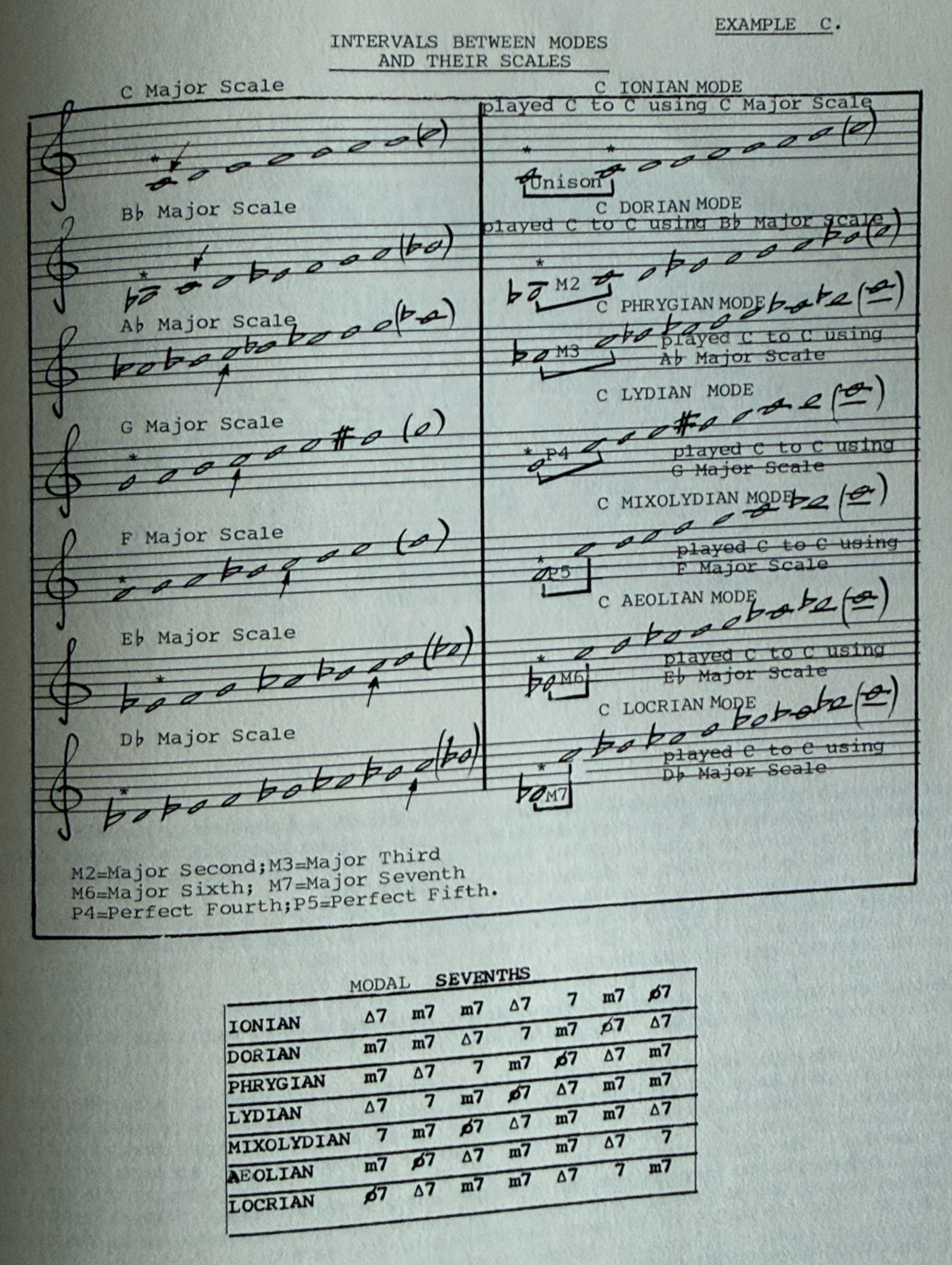
In Examples B and C the method for constructing modes is given. Transposing intervals are given for C modes. The tonic note of any major scale is also the tonic note of the Ionian mode. The Dorian mode is located on the second degree of the scale. So in B♭ Major the Dorian mode is on C, the second degree of that scale (i.e., C to C in the key of B♭ Major). The Dorian mode in A♭ Major is on B♭, the second degree (B♭ to B♭ in the key of A♭ Major). The different modes which appear on C in seven different scales are given in Example B.
Examine Example C: in the left-hand column are seven different scales. The arrow shows where C appears in each scale and the appropriate mode for the seven different C positions is written out in the right-hand column. A composition like "Milestones" has a modal sound. Being modal there is no dominant-tonic which gives the piece a feeling of not being in a particular key. Its harmonic support is economically based on the modal sevenths available. There are three modal sevenths in the A section and two in the B portion.
Improvisation is accomplished by creating new melodic lines from the two different modes. The chords can be almost disregarded as their component notes are part of the modes anyway.
The use of accidentals in the improvisation is not to be encouraged too much because an excess of chromatic notes destroys the modal feeling and defeats the exercise. However, certain notes judiciously placed do not offend the modal character. For example, in D Dorian (D to D in the key of C Major) the Dm7 (the tonic modal seventh) can be altered to a D minor-Major seventh (Dm△7) using the C♯ within the modal scale. Also the natural minor (D Aeolian mode) can be adapted. The B♭ does not clash with Dm7. D Phrygian differs from the Aeolian mode because its second degree is lowered to E♭. There is no problem with fitting in this note with the D Dorian mode. In some versions of "Milestones" the minor-Major seventh is used in the B section.
The Dorian mode can, therefore, be mixed with fragments of the Aeolian and Phrygian modes provided its own characteristics are not submerged in too much deviation. Obviously, these variations give a great deal of scope for making modal improvisation stimulating and exciting.
The other important function of modes in jazz is that they supply scales for many of the chords we use in improvising on the standard evergreens. In the chapter on scales examples were given for C△7, Cm7, C7, and Cø7. They are all modal. See Example B for a list of modes to use with different chords.
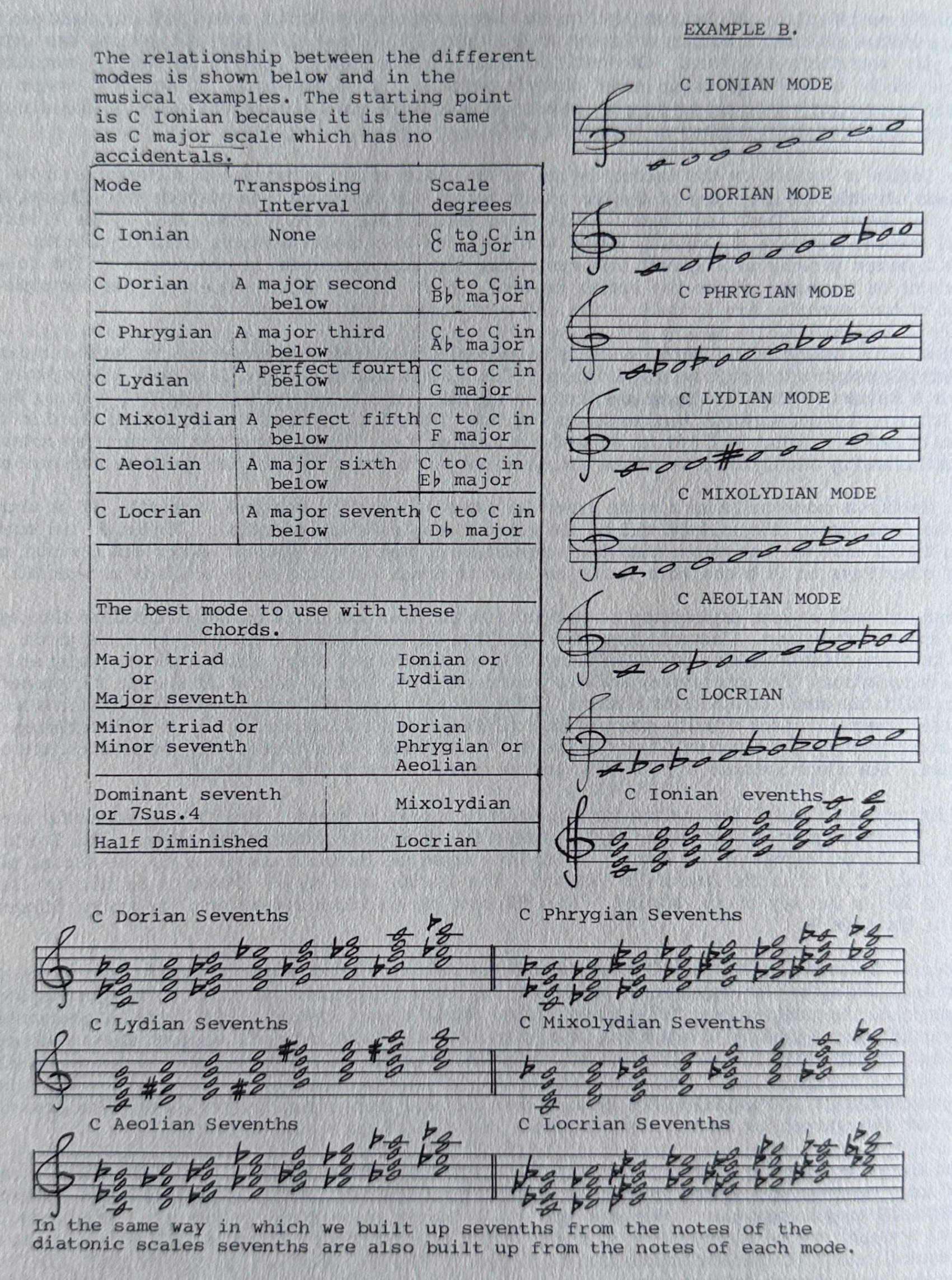
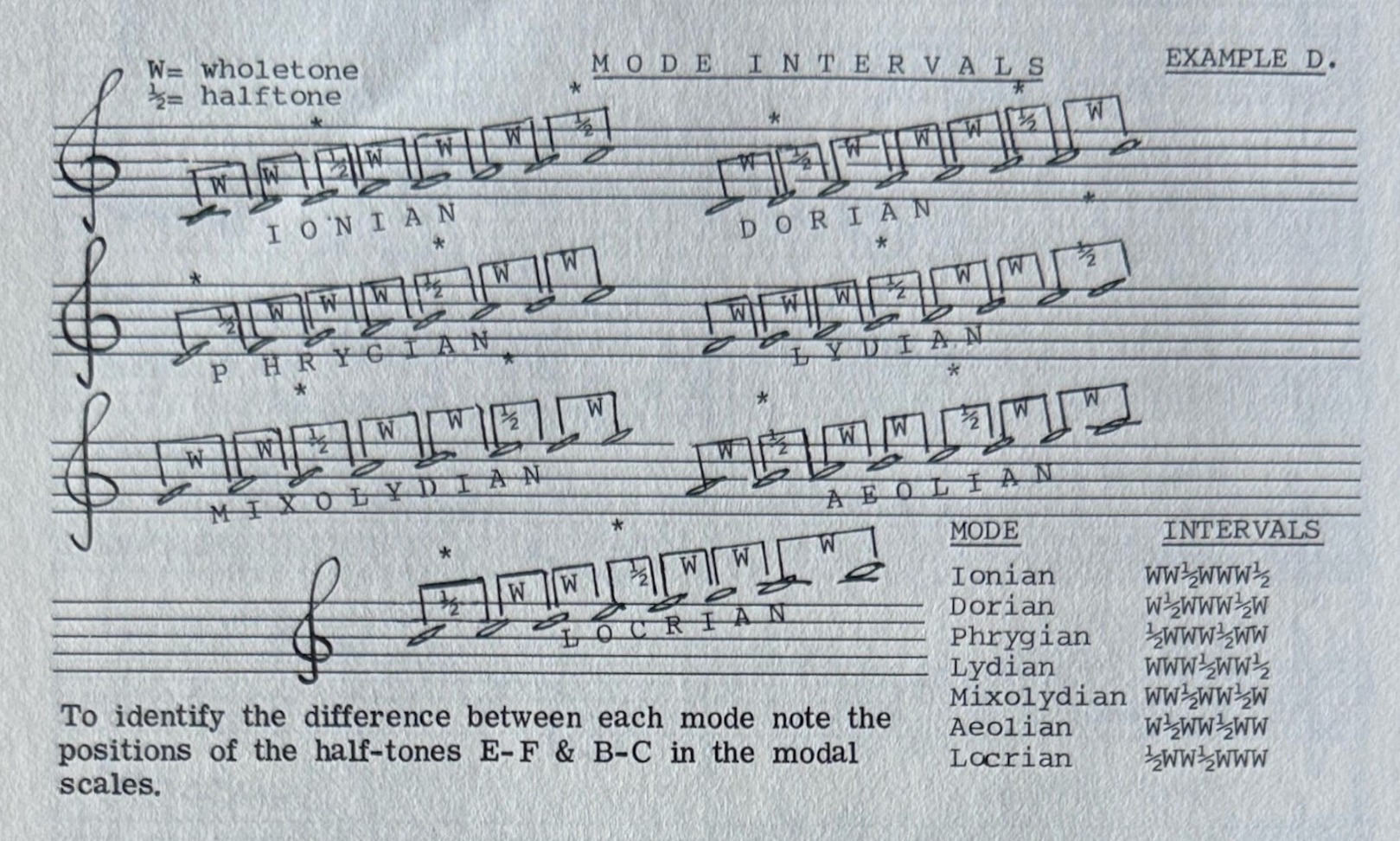
A problem with introducing modes in non-modal compositions is that there is not always enough space or time to make them effective. If the harmony is simple and a chord lasts for two bars or more modal passages fit in. If you come up against a II–V–I chord sequence filling up, say, three bars the Ionian mode scale (Major scale) can be improvised on during this chord movement.
The bitonality we get with the use of tritone substitution also occurs with modal techniques. For example, when the Locrian mode is utilized a D♭ major scale is played with Cø7. When using Cø7–F7 in the key of B♭ there will be two keys, B♭ and D♭.
Most jazz evergreens are not modal. They can be subjected to brief fragments of modal improvisation but only if the harmony can be logically manipulated to allow this to happen.
The use of modes diminishes the strength of the dominant-tonic element in diatonic harmony. In jazz numbers written in minor keys the dominant-tonic is often retained by using minor scale sevenths. There are some compositions written in minor keys which are almost modal and enable improvisation to be created from scales rather than chord changes. One example is Gershwin's "Summertime." Its form is AB with only eight bars in each section. The melody line is written in the Aeolian mode but the harmony although more Aeolian than anything else does borrow from the Dorian mode and minor scale sevenths. With this composition it is possible to improvise on the Aeolian mode (scale) throughout the sixteen bars even though there are a few chromatic chords. You can forget the harmony and concentrate on the scale.
The limitations of using the simple modes of church music are plain to see. They restrict in much the same way as avoiding accidentals and chromatic chords in diatonic harmony restricts the imagination and forces musical ideas into a narrow mold. Nonetheless, modes do help the jazz musician to vary his improvisations and add new dimensions to his approach.
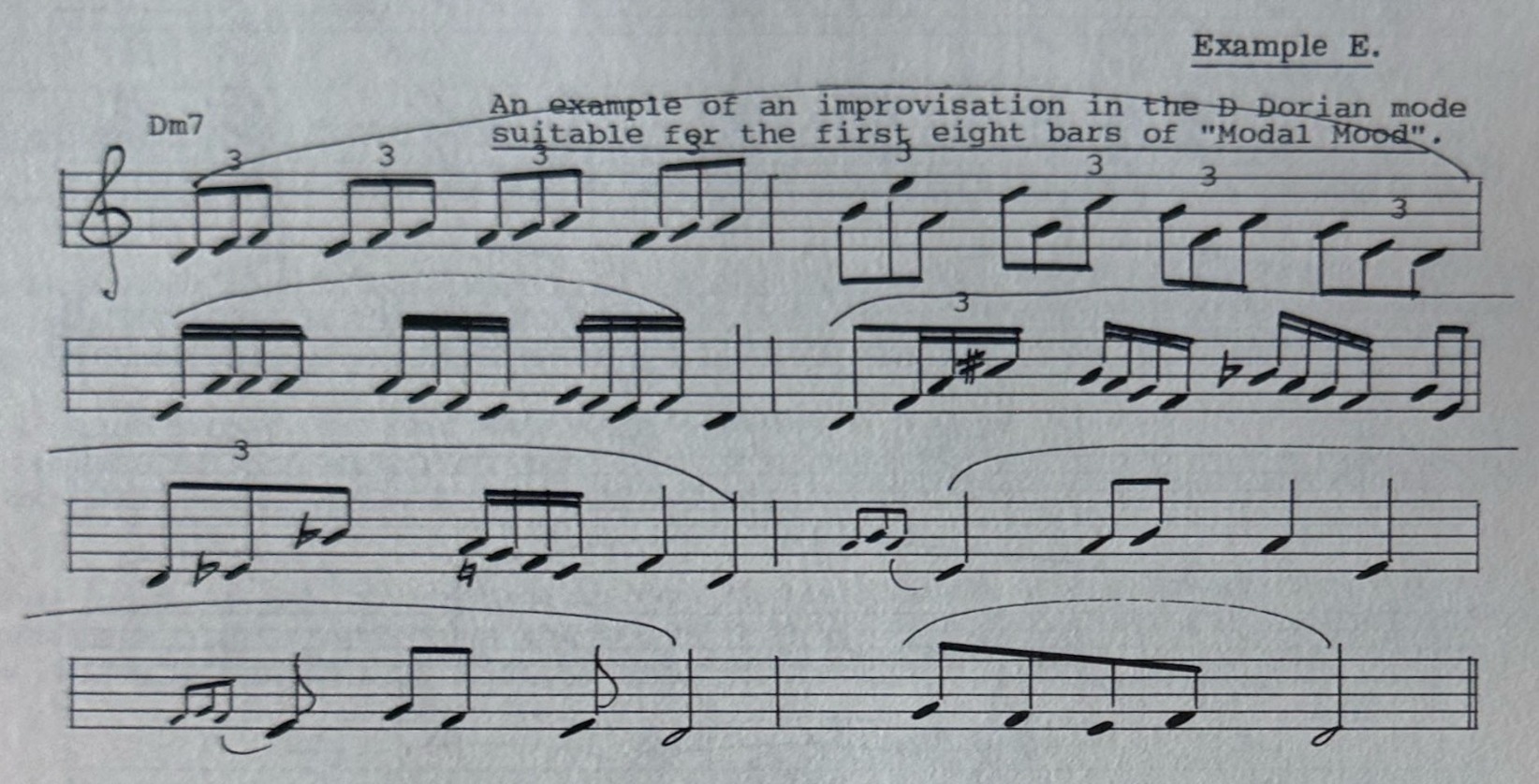
Example E shows what can be done with "Modal Mood."
Although the C Major diatonic scale is modal (Ionian) its modal sound is not noticeable like it is in the other modes. This is because we are used to hearing the Major scale which is the only mode with a dominant-tonic in the V and I positions.
An improvisation on any composition in a Major scale with long passages using diatonic chords can be shaped from the degrees of the Ionian mode. Don't forget that the notes of the diatonic chords are embodied in the modal scale.
Examine the first five bars of the theme used in the chapter on "How To Harmonize a Simple Melody." Forget the chords and construct an improvisation using the notes of F Major scale for the first five bars.
Charlie Parker's "My Little Suede Shoes" (E♭) is a good example of a composition which virtually uses only diatonic chords. An improvisation can be developed for this thirty-two bar theme without straying from the notes of the E♭ Major scale. To do this effectively the scale patterns should emphasize important phrases in the melody line otherwise the improvisation will seem disconnected from the theme.
This exercise gives an idea of one of the many approaches which can be taken when improvising on a scale. Patterns of Fourths are made use of in bar two. In bar four the C♯ taken from a D minor-Major seventh is included as well as the B♭ from the natural minor scale (D Aeolian mode). E♭ and B♭ are borrowed from D Phrygian mode in bar five.
Em7 (a modal seventh from D Dorian) can be added to the basic modal tonic (Dm7) for piano accompaniment purposes. Other sevenths from the same mode can be used as well if you think they are relevant.
Improvisation is essentially based on the D Dorian scale borrowing a little from the Phrygian and Aeolian modes. It is not concerned with any chords which might appear in the accompaniment.