Ragtime
Ragtime has had a long and interesting history. We are all familiar with popular rags like "Maple Leaf Rag," "The Entertainer," and "The Black And White Rag." In fact many people associate "Rag" with a sound--a gay, lively number with a strong rhythmic pulse to set the foot tapping: something you would hear played by a dixieland group.
The form of ragtime is contrasted to the thirty-two bar numbers which have dominated jazz and dance music for so many years. Ragtime consists of three or four quite different themes of sixteen bars' length played with an even rhythm in 2/4 time. The melody with its varying patterns gives a strong feeling of syncopation. We are not so conscious of this element nowadays with well over half a century of jazz behind us. In those early days at the turn of the century syncopation was more of a novelty.
Ragtime was created at a time when most music was read and the composers' instructions were followed faithfully. Scott Joplin, for instance, insisted that his rags should be played as written. As many of the pioneer piano players who moved around the saloons and clubs seem to have played the rags in their own styles, Joplin was probably responsible for all the arbitrary rules that have been imposed on classic rags.
After the enormous success of Joplin's "Maple Leaf Rag" (1899) his name was associated with rags more than any other composer. It is not surprising that the tradition of playing classic rags as written has been perpetuated. Scott Joplin's instructions urged the player to avoid careless reading and playing. He added the warning that by playing his rags too fast the right effect can be entirely lost. This was propounded in 1899 but things have changed since then.
Ragtime enjoyed a revival and Joplin compositions were given a new lease on life after the Paul Newman film of The Sting (1973) in which "The Entertainer Rag" was the theme music.
Joplin was a prolific writer of rags; however, there are many other ragtime composers of importance like Joseph Lamb, James Scott, Tom Turpin, Eubie Blake, and James P. Johnson. The list is far too numerous to name all the important figures in ragtime history.
Ragtime like other minority styles (Boogie and Blues) has been kept alive by dedicated pianists such as Ralph Sutton, Dick Wellstood, and Neville Dickie. Lou Busch wrote a large number of rags and made them popular in the fifties and sixties when he was working under the pseudonym of Joe "Fingers" Carr. Unfortunately, some diehard purists regarded him as being too commercial and he did not seem to enjoy the recognition he deserved. Listening to his LPs now reveals how underrated he was.
Numerous LPs have been issued of various Joplin rags since The Sting was shown in the cinemas. If they are performed as written it seems to me that only one good recording is needed unless some imaginative pianist breaks away from the rigid Joplin rules of performance.
I am in favor of pianists playing Joplin or other ragtime composers as they please. The amount of alteration will depend on the composition. Joplin wrote a number of very good rags as well as less interesting ones churned out to meet the public demand as his popularity grew. All would benefit from being given a shot in the arm. They could be embellished, arranged, or improvised; they could be given a modern sound. Nobody seems to mind "Maple Leaf Rag" being altered so why not the others?
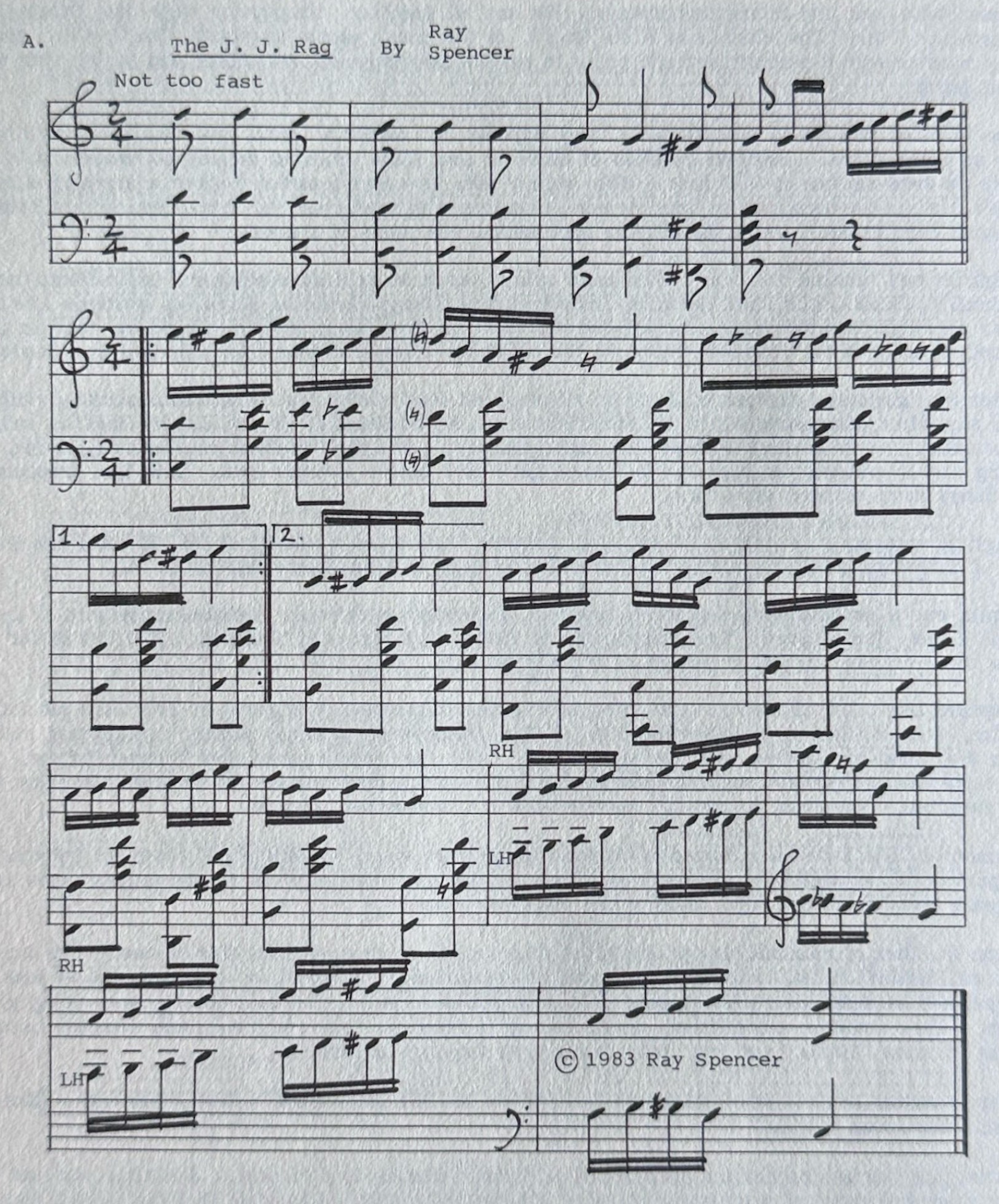
I have written out an introduction and one sixteen bar theme of a rag in the Joplin style (Example A) to show what the sound is like.
During the thirties publishers changed all 2/4 instrumentals to 4/4 time. 2/4 time was out of date and in any case 4/4 time is much easier to read. Some authorities on ragtime feel that how a pianist plays a rag does not alter the fact that ragtime is a form of music and not the way a piece is played. In other words jazz is a way of playing and not necessarily a particular kind of composition.
When Ralph Sutton was asked to play a Joplin rag for a TV show he played it his way in spite of the program directors wanting him to play it "straight." In 1975 Dick Hyman recorded all Scott Joplin's rags, marches, and waltzes. He not only played the lot as written but he reworked twelve compositions in his own style. George Shearing recorded "The Entertainer Rag" in his very individual style.
There are a number of alternative approaches which can be used to give new life to Joplin compositions and other rags. They can be played in 4/4 time in a stride style giving them a more rhythmic swing. Embellishments like grace notes can be introduced where appropriate. The more skilled jazz pianist can change the harmonic structure and alter the sound without interfering with the melody too much. This can lead on to out-and-out improvisation to stimulate and excite the listener. The first choice of alternatives is the least demanding. Work out the chords from the written music; break up some of the chords into thirds in the stride fashion and try to introduce other ideas in this vein.
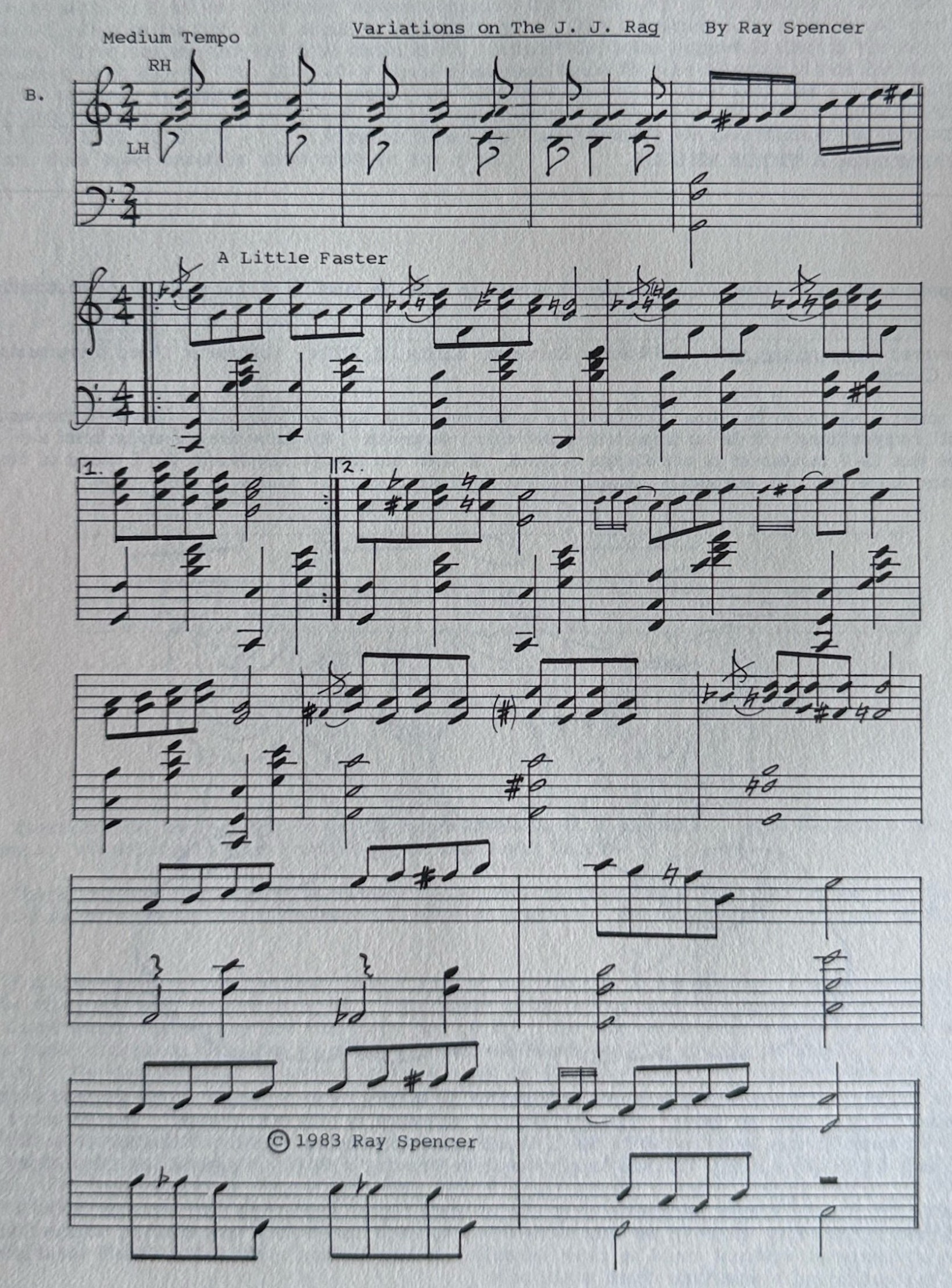
In Example B I have adapted Example A into a straightforward stride ragtime style. The alterations are quite simple; I hope it will encourage more enterprising pianists to tackle Joplin and other ragtime composers with a fresh and freer outlook.