Roman Numerals
The use of numbers instead of notes dates back to the figured bass of the seventeenth century. It was designed to make the accompanists' task easier. The written note in the bass represented the root of the chord to be formed; Arabic figures showed the intervals to be added. Later on inversions were also indicated by figures. This musical shorthand has been used in some form or other ever since. Roman numerals eventually took over the role of notes on a staff to signify the roots of different chords. Although it is not clear how or when Roman numerals came into use their introduction helped to avoid confusion in interpreting bundles of figures quickly.
Each note of a diatonic scale can be given a Roman numeral in order from the tonic. As the chords of each degree of a diatonic scale are the same in all keys the numbering of these degrees enables the student to painlessly transfer a chord sequence from one key to another without the need for modification or alteration which is necessary when conventional chord symbols are used.
Some American books on jazz theory and improvisation urge the musician to learn the harmony of everything he plays using Roman numerals so that all tunes can be immediately transposed to any key likely to be called. This is a wonderful ideal which would be feasible if sheet music displayed Roman numerals as well as or in place of chord symbols. I have yet to hear of any musician who has tackled the endless task of converting his repertoire of numbers into Roman numerals and committing it to memory. Nevertheless, Roman numerals are widely used in teaching and books on jazz harmony and improvisation assume the reader is familiar with the system.
In a major diatonic scale in C the sevenths built on each degree of the scale are shown in the table below:
| C-Tonic | I | is always a major seventh | (CΔ7) |
|---|---|---|---|
| D-Supertonic | II | is always a minor seventh | (Dm7) |
| E-Mediant | III | is always a minor seventh | (Em7) |
| F-Subdominant | IV | is always a major seventh | (FΔ7) |
| G-Dominant | V | is always a dominant seventh | (G7) |
| A-Submediant | VI | is always a minor seventh | (Am7) |
| B-Leading Note | VII | is always a half-diminished seventh | (Bø7) |
I, II and III in B♭ would be: B♭Δ7-Cm7-Dm7; and in E♭: E♭Δ7-Fm7-Gm7; the appropriate chords for any scale are very easy to work out.
The rules or principles by which certain chords follow one another are often referred to as their function. Roman numerals can be arranged to show these relationships. For example, a II chord moves towards a V chord; a V moves towards a I chord; VI to II; III to VI; VII to III; IV to VII and a I chord towards a IV chord.
Up to now we have concentrated on diatonic scales and chords. If a diatonic chord is altered by adding non-diatonic notes or its character is changed by raising or lowering one of the notes of its component intervals the chord becomes chromatic. A chord needs to have only one note added which is not natural to the scale from which it is formed to become chromatic.

Minor Scale Sevenths
All major scales have a relative minor and both scales share the same key signature. The keynote of the relative minor is on the sixth note of the major scale.
There were no problems in forming diatonic sevenths by using just the notes of the major scale but as there are three different minor scales chord building on these scales is not so clearly defined. C minor scales are shown in A1, A2 & A3.

You can see from the above list the scales from which each chord is taken. The chords formed on I, II, IV, V, and VII could also be taken from the Harmonic minor scale. The chords associated with III and VI are not duplicated in the same way (See B3).

The III chord is sometimes given as a major seventh with an augmented fifth. The major seventh is a more adaptable chord.
Minor scale triads are given in example B2 because you will find areas of melody where a minor scale triad seems quite adequate. Some minor chord sequences use a minor triad with an added sixth in the I (root) position instead of the minor Major seventh.

There are a few compositions in minor keys but fragments of minor keys often appear in major keys so a familiarity with minor chord movements is valuable.
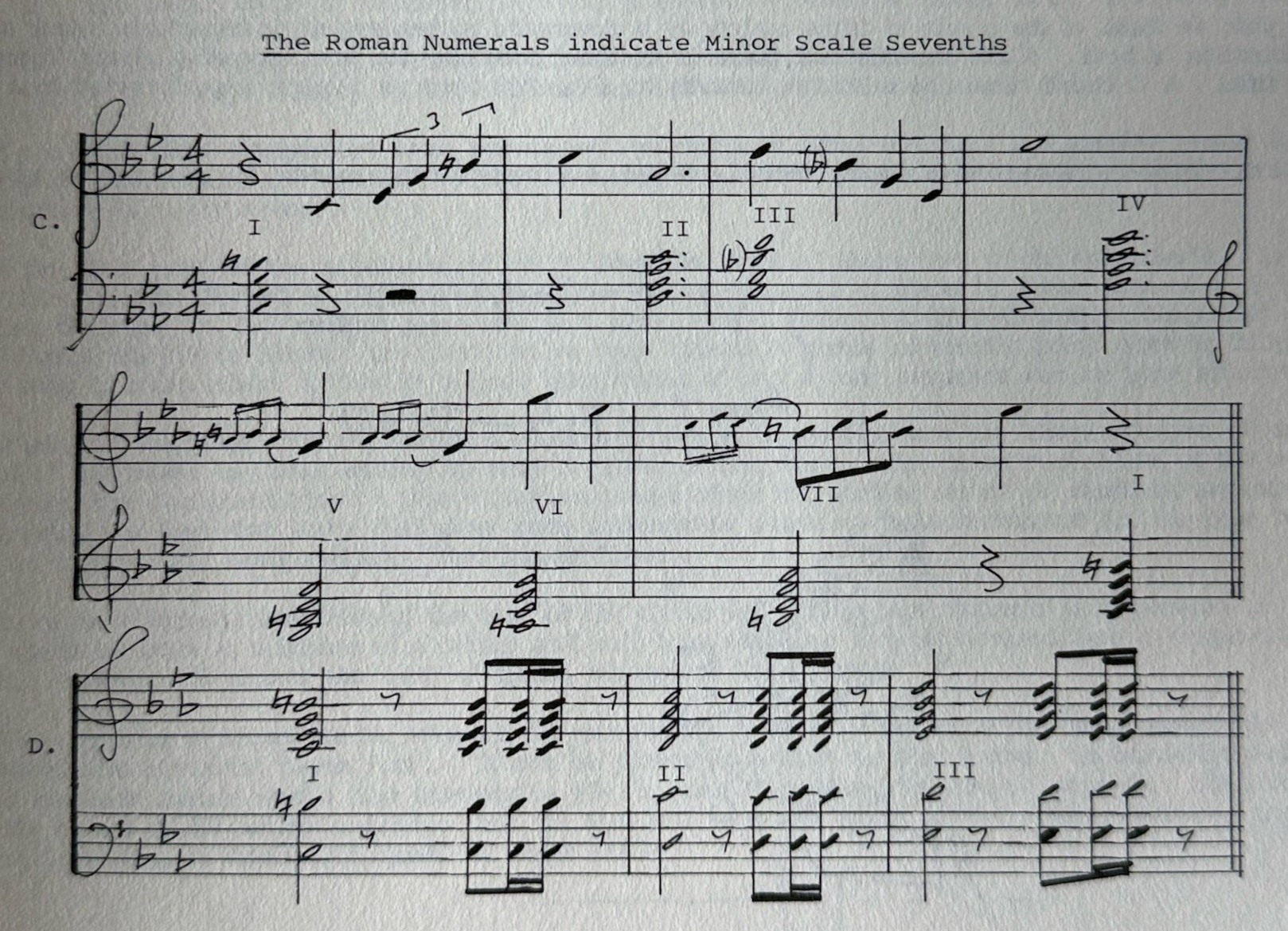
Examples C and D show the character of minor scale chord sequences. They have a sound of their own which is very attractive and slightly boppish in feeling. It is surprising that composers do not experiment more with minor modes.
Interesting compositions in minor keys or with a strong minor feeling are: "Bei Meir Bist Du Shoen," "Autumn Leaves," "Summertime," "Autumn In New York," "Loverman," the interlude of "Night In Tunisia," "Brother, Can You Spare A Dime?" and "Lullaby Of The Leaves." Cole Porter is one of the few composers who has created lasting melodies in minor keys or with a minor sound. Notable examples are: "I Love Me," "I Love Paris," "It's Bad For Me," "You'd Be So Nice To Come Home To," "My Heart Belongs To Daddy," "It's Alright With Me," and "Just One Of Those Things."