Twelve Bar Blues
When somebody says, "Let's play a blues" all you need to know is the key and the tempo. The meaning of "blues" to most musicians is a particular twelve-bar sequence. The chord changes are quite simple because essentially the blues is based on three chords--the tonic, subdominant, and dominant of the chosen key.
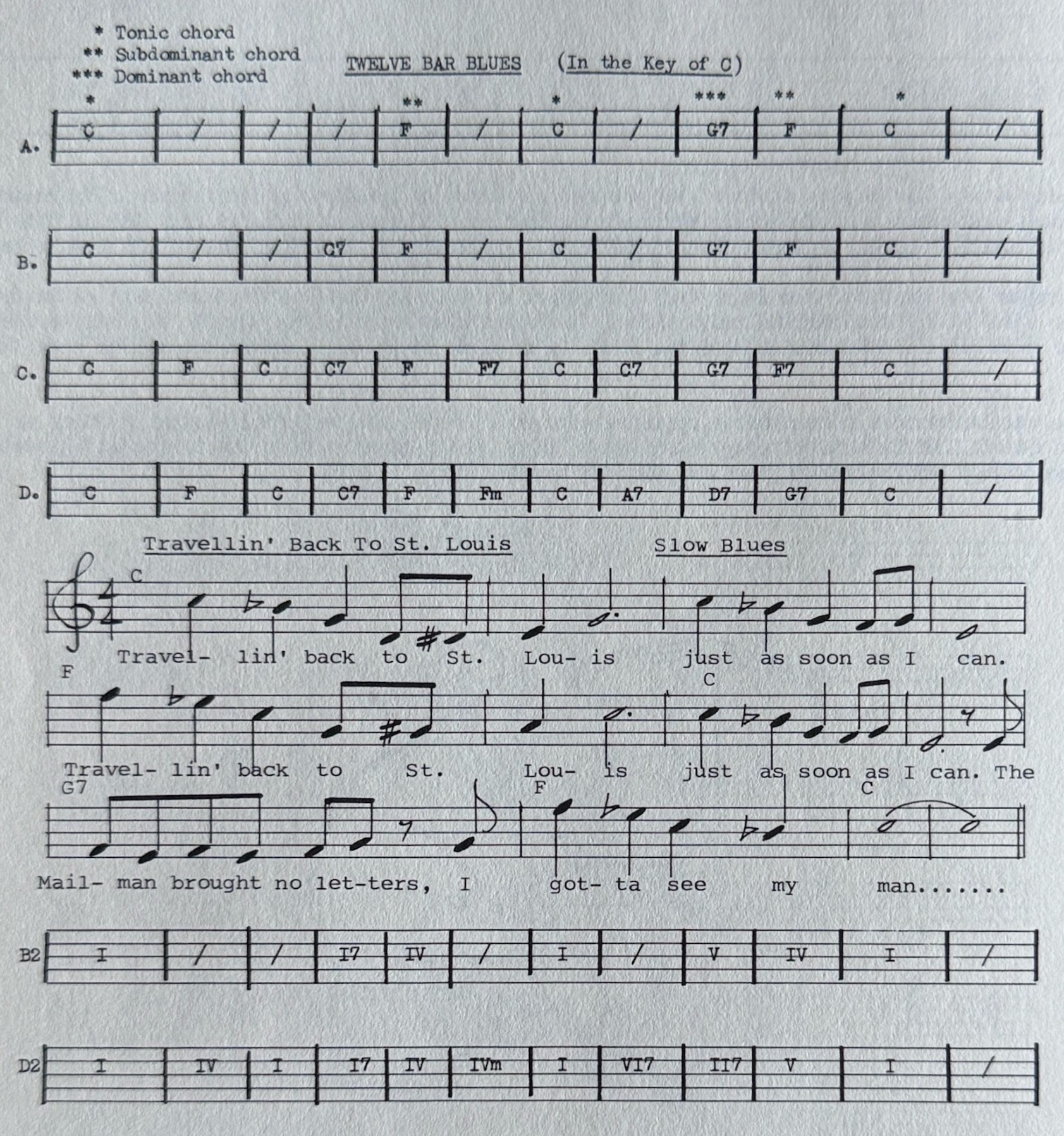
In a major key the first four bars would be played on a major triad on the tonic note of the key followed by two bars on the subdominant major triad, two more bars on the tonic chord, one bar on the dominant seventh, one more on the subdominant and two bars on the tonic chord to complete the twelve bars (Example A).
There can be various permutations on these chords. Chords can be added to give a fuller or more sophisticated sound. But whatever changes are made to the basic chord pattern the twelve-bar blues sound should not be lost or smothered by your amendments and additions.
There are eight-bar blues, sixteen-bar blues and blues in minor keys and modern jazz versions of the twelve-bar sequence. Nonetheless, when anybody calls for a blues it is the twelve-bar kind in a major key which is required.
In the three-line stanza of the twelve-bar blues the first line which covers four bars is usually repeated for another four bars. The third line (also four bars) completes the twelve-bar sequence. Here is an example of the kind of verse which fits into the blues form outlined:
Travellin' back to St. Louis just as soon as I can;
Travellin' back to St. Louis just as soon as I can.
The mailman brought no letters, I gotta see my man.
Although most blues have lyrics and it is good to hear them sung, an instrument can be just as persuasive in putting across the twelve-bar blues theme.
There are many commercial blues numbers; very few are inspired. I feel that it is sometimes better to avoid the commercial songs because the twelve-bar blues gives greater freedom and scope for creative improvisation if you make up your own melody and develop solos on your own theme. Simple guidelines for improvisation show that like the lines in each verse you create a phrase, repeat it and work out another different phrase to fit into the dominant-subdominant-tonic in the last four bars.
There are hundreds of compositions which are rooted in the twelve-bar blues. The repertoires of great jazzmen like Louis Armstrong and Duke Ellington included many blues. The blues is such an essential part of jazz that its influence is apparent in all periods of its history. It is found in the recordings of early black and white jazz bands up to the contemporary bands of today.
I feel that it is very useful to understand the blues and to study the styles of the great blues players. It helps to give your playing of non-blues tunes a jazz feeling that is not always easy for the beginner to display. Many ballads and slow numbers benefit from "blues" phrasing in appropriate places. I sometimes feel that some of the accomplished young modern jazz players would benefit from a study of the blues; it might give their playing more authenticity and make the listener less aware of the technique displayed and more conscious of the jazz feeling in what they play.
In Examples B, C, and D you will find twelve-bar blues in which the chord sequence in Example A has been altered without losing the essential blues form.
The blues, of course, can be played in any key you like. B♭ is perhaps the most popular key and the most comfortable for front line musicians. Next in preference might be E♭ and A♭. Blues pianists or boogie soloists have a liking for C, G, F, and B♭. C and G are popular in boogie woogie because the tricky left-hand patterns come easier in these two keys.
As the twelve-bar blues chord sequence is the same no matter which key is chosen I have written out the blues chords in Roman numerals (Examples B2 & D2) so that the student can play in any key without wondering how to transpose the chords.
The blues have been the greatest and most rewarding influence in jazz. To forget these roots is almost to forsake jazz itself. If you want to become good at the blues try to create blues of your own. Work out a couple of three-line verses then sing them to yourself. Think of a line, repeat it and round off the idea in the third line. For example:
I've lost my job, I'm moving from this town,
I've lost my job, I'm moving from this town,
Got to keep on trying, but leaving gets me down!
The first line starts off backed by the tonic chord of the key. The second line has the same melodic idea but this time it is played a fourth up so that it is supported by the subdominant chord for two bars.
Experiment a bit, try out various verses. It does not matter if they sound a bit corny as long as the words fit into the pattern of the three four-bar sequences. It's all practice. When you think you have got a melody line for your verses then try to play it on the piano. You know what chords to use: only three are needed.
The examples of blues illustrated are variations on the "St. Louis" theme. (Examples A and B). The blues I have written out in Example C use the chords shown in Example D.
The left-hand accompaniment can be sustained chords for the harmony given. If you have a look at the intervals in Example D you will see what to do. Play a chord to a bar. I have used an interval of a tenth for the Fm and A7 chords as it sounds nicer. I have given an indication of the fingering for each blues. Fingering in jazz is often unorthodox. Fingering for one pianist might not suit other players. The fingering I have indicated is alright for me. It is only a guide so if you have, for instance, a small hand you will possibly find a fingering of your own better. Fingering is right if it's comfortable. Don't distort your hand struggling with a difficult progression. Your hands should be relaxed.

Contemporary Influences
It is a matter of taste whether you prefer your blues played in a traditional manner or in an updated version liberally scattered with way-out chords and patterns. Regarding this choice between the old and the new I must say that I think that no modern blues stylists can equal the fundamental approach of marvelous exponents like Pete Johnson and Meade Lux Lewis. But whatever jazz we like personally, new developments and directions are tried out and followed.
Have a look at the variations I have written on my "Battersea Blues" (See Circle of Fifths for the original version). I have chosen this example because it shows how the circle of fifths can be used to break away from basic blues chords. I have written in the left hand chords in full so that the correct sound is clear. When you have got the feeling you can abbreviate the chords to allow a more effective improvisation to be worked out in the right hand (Example A).
In "Little Susie" Ray Bryant created an individual style of playing the blues by preceding every dominant seventh with another dominant seventh half a step below it. I have used this device in my second blues solo (Example B).
If you study the chords used in these two examples you will realize that they are much more complicated than the basic three chords of early blues compositions.

When you wish to introduce circle movements like those used in Example A you will have to think backwards. In a simple blues you would have four bars of C with, probably, a C7 in the fourth bar to lead into F or F7 in the fifth bar. Working out the chords before you play them you will need to move backwards from C7 in the fourth bar in whole steps. As you can see this movement is C7–Gm7–D7–Am7–E7–Bø7. The ø7 and m7 chords are in whole steps: Bø7–Am7–Gm7 (going forward this time). Instead of moving from the C7♭5 directly to the F7 I have introduced a Cm7 to fill out the harmony in that fifth bar. In bar eight the E♭7 chord is a tritone substitution for A7. In bar eleven the D♭7 is another similar substitution--this time for G7. So bars eight and nine as well as ten and eleven are circle of fifths movements in whole steps.
In Examples C, D, and E I have written out just two bars of a blues with three alternative kinds of left hand support: diatonic, chromatic, and rootless three-note thirteenths. I thought this might set you off on a different course.
There is no reason why the student should not invent his own melody for the chord sequence in "Battersea Blues." The original version was in B♭; the variations are written in C. If you try the chord sequence in, say, F, G or E♭ a different melodic feel could produce a new angle or some new ideas. To help I have written the chord changes in Roman numerals so that any key can be established fairly quickly.

To refresh your memories the following listing will remind you how to use the Roman numeral system:
I = Major Seventh
II = Minor Seventh
III = Minor Seventh
IV = Major Seventh
V = Dominant Seventh
VI = Minor Seventh
VII = Half-Diminished Seventh
I is located on the tonic note of the major scale in use; II is positioned on the second degree of the scale, and so on. This is harmony based on the diatonic scale. Any variations or deviations are shown like this: ♯I and ♭I means that you play a major seventh half a tone up or down from the tonic note of the scale. I7, Im7, or Iø7 means that instead of playing a major seventh on the tonic note you play either a dominant seventh, a minor seventh, or a diminished seventh instead. This kind of alteration applies to any other Roman numeral, so that, for instance, Vm7 means that you play a minor seventh on the fifth degree of the scale instead of a dominant seventh.
